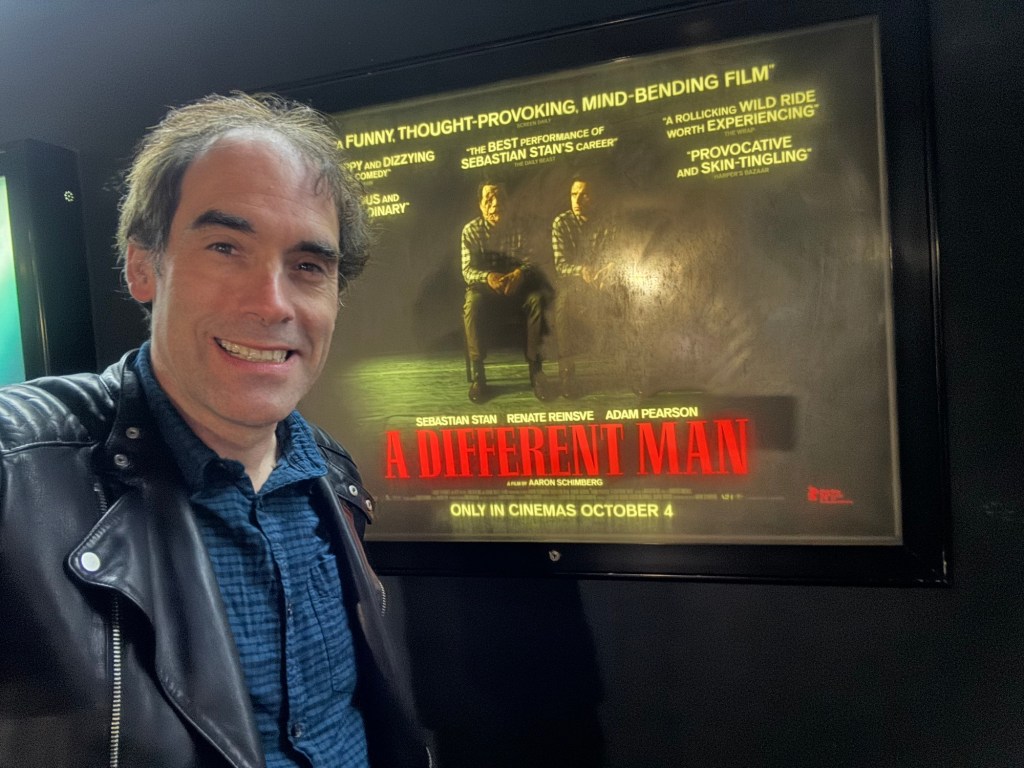
‘A Different Man’ is a remarkable film, one which crosses genres in a similar way to ‘The Substance’ and asks how different personae work in different contexts and how we necessarily engage differently in different social circumstances with the people around us, and are probably rarely comfortable in any one guise. This takes a surreal turn when a man called Edward (Sebastian Stan) with benign tumours on his face, a condition known as neurofibromatosis, becomes the subject of a play written by his playwright neighbour, Ingrid (Renate Reinsve), and his condition is so normalized by her – indeed, she is drawn to him emotionally, even sexually – that when experimental treatment causes him to lose his tumours and look like a conventional Hollywood movie star, he is no longer noticed by the people who were previously attracted to him.
He changes his name to Guy, and kills off his former incarnation, but cannot escape the need to be loved by Ingrid. He then shows up at an audition for the play where Edward is the main character, but only succeeds in persuading Ingrid that he is the right man for the role when he literally dons the mask – in the form of the plaster mould from his previous face – and inhabits the role. But, and this is where the film moves into even more bizarre circumstances, a man with neurofibromatosism, Oswald (Adam Pearson), turns up during one of the rehearsals and keeps appearing everywhere that Guy is and supplants Guy in Ingrid’s estimation, and this is where Edward/Guy’s entire character arc then disintegrates.
Guy has already killed off Edward, and then does an effective job of destroying Guy, and with it the film mutates into a completely different genre, with Guy suddenly erupting and acting in ways for which the film has not hitherto allowed. ‘A Different Man’ is an audacious piece of filmmaking, in which Oswald himself is not even remotely like the character Ingrid has written, and it is the way he is so unfazed by the attention he is getting and actually manages to reshape and rewrite the script, increasingly pushing out Guy in the process, that makes this one of the most beguiling and absurd films since ‘Being John Malkovich’.
There is something so clever about a film which simultaneously weaves together a non-disabled view of disability and a disabled view of non-disability, and nothing appears to be off limits. It is Edward’s lack of self-esteem in contradistinction to Guy that stands out in a film which is so good at interrogating stereotypes and which presents disability as a far more transformative and cathartic experience than that which is seen through a non-disabled lens. So, here is a film which deftly asks what is the nature of beauty and who gets to define, let alone embody it.


 Chris Deacy
Leave a comment