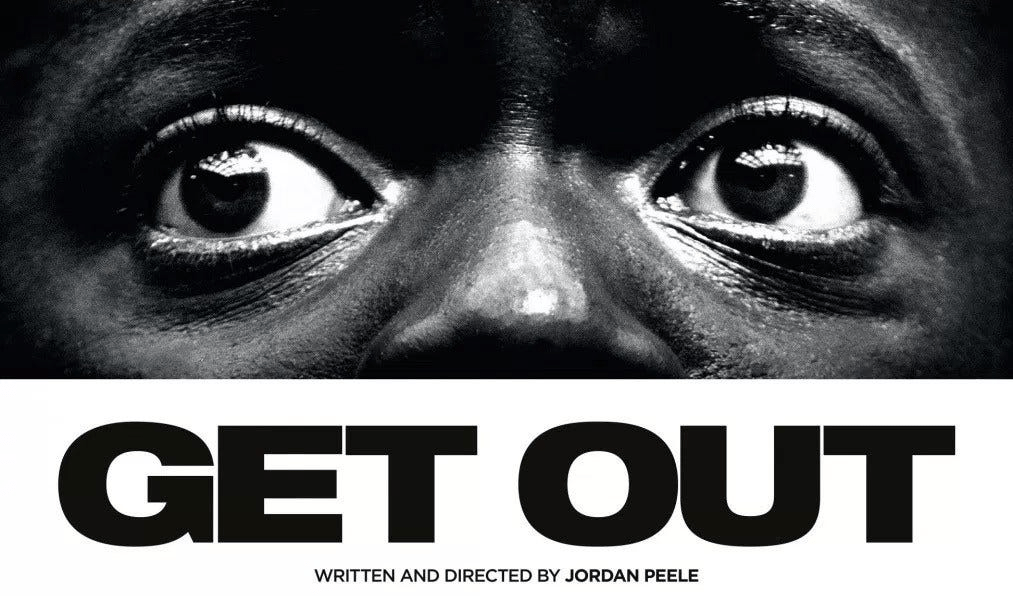
‘Get Out’ is a masterclass in how to revitalize and reshape the horror genre by giving it a distinctly grounded milieu and in its foregrounding of contemporary themes and tropes relating to racism and gaslighting. The relatable angle comes in the form of what is at first a seemingly cohesive couple of different racial backgrounds – Chris (Daniel Kaluuya) is black and Rose (Allison Williams) is white – and they are about to pay a visit to her parents, with Chris fearful that they won’t take to him because of his skin colour.
What follows is a terrifying incursion into the underside of America where the wokeness of the language used (‘I would have voted for Obama for a third term’ asserts Rose’s father in what appears to be a concerted effort to make Chris feel at ease and welcome in their home) conceals something far more insidious. There is a ‘Stepford Wives’ and ‘A Clockwork Orange’ subtext too in terms of the questions of mind control and identity that the film throws up in an original (and Oscar winning) screenplay which focuses on the racism not of rednecks but of the suburban liberal elite whose privilege and education makes them less obvious repositories of structural racism.
Jordan Peele has fashioned a film which builds on the steady realization that something simply isn’t right, and that friends, or relationship partners, may have agendas which we hadn’t counted on when we took them into our confidence, or they into ours. The film involves at one point a character we have had no reason to distrust having kept a photo album of all their previous relationships, and it is at this point that we see the story no longer checks out and the entire edifice of what we have hitherto taken for granted is challenged. And it is not just Chris who we see falling, under hypnosis, through the sky.
The stability of the worldview we see before us is itself no longer secure, and it is refreshing to see the horror genre being utilized for what is, ultimately, a case study in paranoia or conspiracy. Chris has up until this point taken institutional racism as a given. When, for example, a white cop treats him differently to Rose when their car is pulled over on the way to the ‘meet the parents’ scenario, Chris shrugs it off as something that happens all the time.
But, there is a line between acquiescence and resistance – even open revolt – and this film charts that progress with an escalating sense of menace, unease and suspicion. There is a ‘Twilight Zone’ element to the way the at times fantastical story unfolds, to the point that the film comprises a cross between ‘Invasion of the Body Snatchers’ and ‘Guess Who’s Coming To Dinner’, while having something relevant and incisive to say about modern supposedly post-racial America. Hypnotically good in more ways than one


 Chris Deacy
Leave a comment