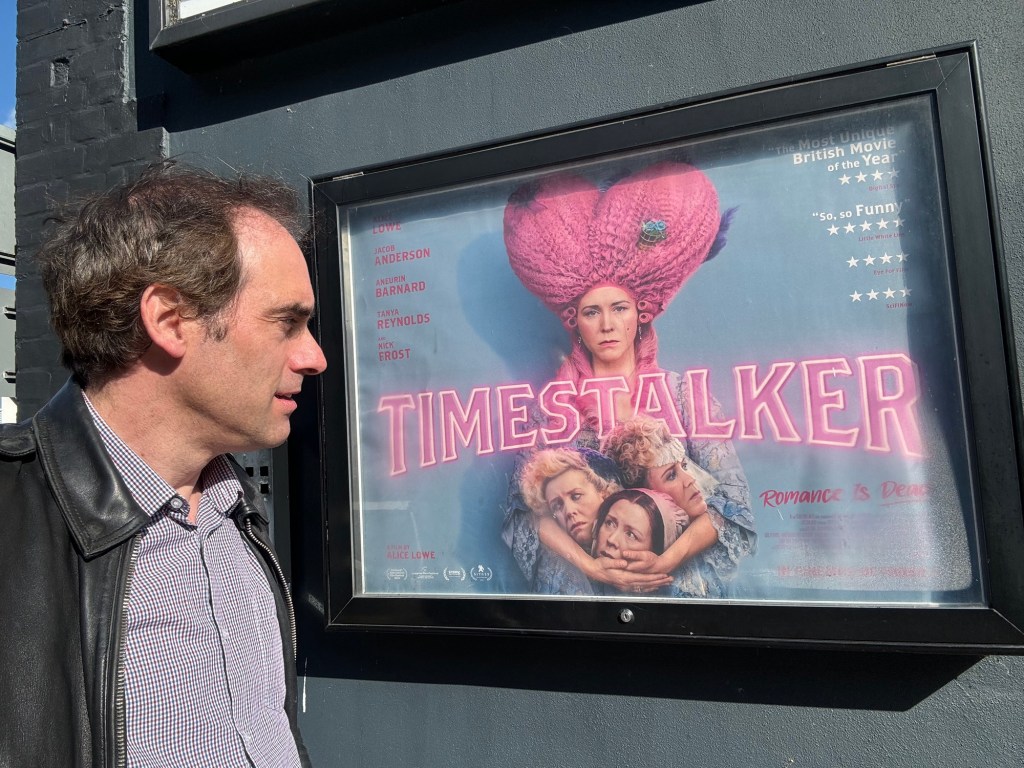
‘Timestalker’ is in the Monty Python vein as a scattershot comedy, set in different eras and reminiscent of ‘The Beast’, also from 2024, with its brew of immortality (here specifically the possibility of reincarnation) and in giving us a female protagonist who appears in different eras and attempts to weave together the various strands which appear to be pointing her towards her soulmate who appears as a potential love interest from the seventeenth century onwards. With a series of episodes set in 1688, 1793, 1847, 1980 and 2117, we begin by imagining that Agnes (Alice Lowe) is searching throughout history for the love of her life.
But, as the narrative and the years pass, we become increasingly aware that there is a delusion at the heart of Alice’s searching for Alex (Aneurin Barnard), who appears as a heretic, a highwayman, or a pop star from the New Romantic era, as each time she encounters him the love appears to be uni-directional and we start to question exactly who is stalking whom across time. The same people appear in each of the eras, acting as a Greek chorus, and giving Alice the advice and succour she is looking for, and this gives us an opportunity to consider whether we are programmed to act in the same way, effectively for an eternity, or whether we are capable of changing our fate.
Alice is always looking for something, or someone, that eludes her, and she becomes forced to consider the possibility that the object of her affection may be misplaced. Reincarnation is a major theme of this ideas-led often bawdy comedy, but where ‘Timestalker’ has a particular distinction is in the way that it asks the question whether we are living the same but different lives or whether it may actually be someone else’s life that we are tapping into, and that they may be the ones having the memory or the dream about us. Agnes keeps receiving glimpses of herself in the different eras and it is for us to deduce whether they might be flash forwards or flashbacks.
The fact that Agnes also has a stalker of her own, in the form of Nick Frost who plays a boorish husband in the 18th century sequence, lends an extra layer to the story of who is exactly in control of the narrative. We may want to lay down our own lives for that of another, as Alice does repeatedly during the different time periods, but Alex does not exactly reciprocate, and this aspect of the film – where that other person may not exactly know or appreciate the nature of such sacrifice – has considerable depth. It is, however, for the most part a lighthearted, episodic rendering which does not always fit together but whose ideas are sharp.
In seeing the same events from different perspectives I was reminded of the dressing room scene in Tarantino’s ‘Jackie Brown’ where we see how one event can be open to multiple interpretations depending on the point of view being focused on at any one moment. And this is where ‘Timestalker’, in all its platitudes and visual comedy, is at its most effective, giving sustenance to the idea that the goals and dreams we have, and which often sustain us throughout our lives, may actually be chronically misplaced and delusional, in turn begging the question as to what exactly is the purpose or benefit of immortality, especially if there is nothing learned from each successive life.


 Chris Deacy
Leave a comment