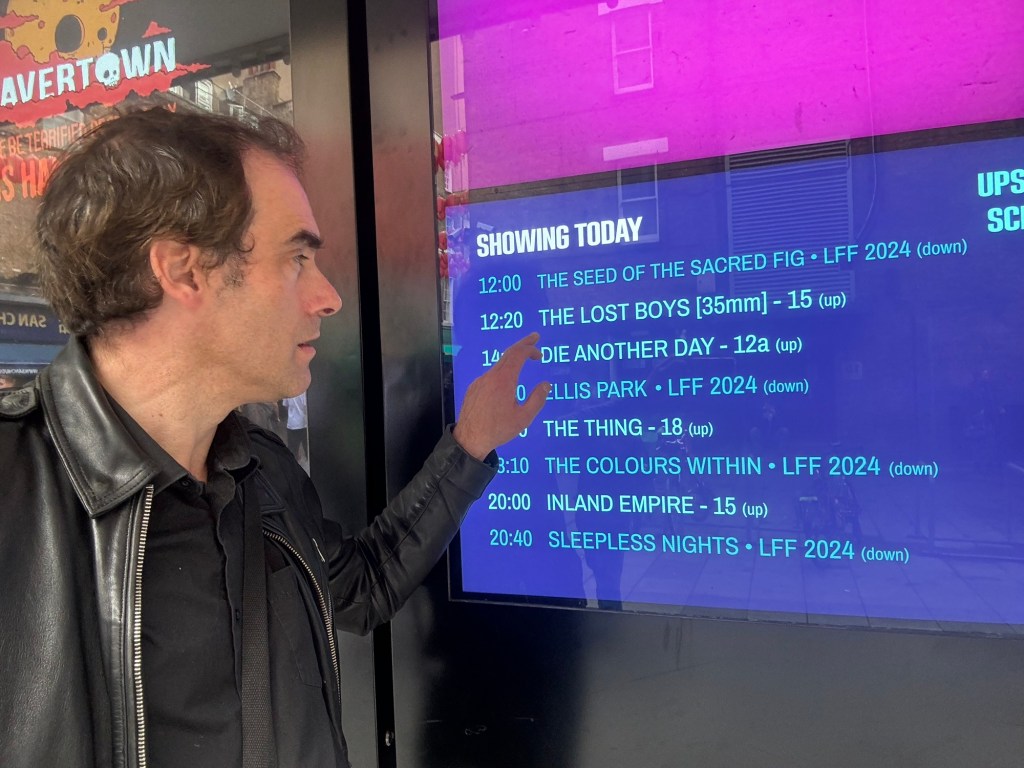
‘The Lost Boys’ is an 80s nostalgic coming of age narrative, with the sort of blend previously administered in ‘The Karate Kid’ and ‘Back to the Future’ of real world family and school pressures interspersed with magical flights of fancy which are employed to facilitate, Jungian style, the hero’s journey away from the obstacles that surmount them towards enlightenment and self-realization. ‘Dirty Dancing’, also from 1987, exhibits the same rites of passage narrative, in that case using dance as the magical elixir that enables adulthood to be reached.
In the case of ‘The Lost Boys’, two teenage sons of single mother Lucy (Dianne Wiest) arrive in a small town in California to begin a new life, and are attracted to (and no less repelled by) the dark side represented by a group of local bad boys, headed by Kiefer Sutherland, whose and which is taken to the literal extreme of revealing them to be vampires. The film has the younger brother, Sam (Corey Haim), suspecting that his older brother Michael (Jason Patric) has been possessed, and he sets about trying to find ever more ingenious means, ‘Salem’s Lot’-style, to ward off the vampire that Michael has become.
There is a Peter Pan element to this film, with its themes of young children being snatched by an external force and where, so the conceit goes, in being turned into vampires children can stay children, and immortal, forever. But whether or not that is a good thing is a trope that the film plays out, in what is a never entirely serious or deep revisiting of the vampire legend. Relocating it to a modern day coastal community in America means gives ‘The Lost Boys’ some element of charm and humour which is often endearing, but there isn’t a very successful integration of the different ingredients.
Everyone, including the grandpa with whom the family stays, is really just a child at heart, the film suggests, and we even see him playing dead the first time we encounter him – in a way that doesn’t remotely perturb or surprise his daughter Lucy – and this is really difficult to take as anything other than a well choreographed tale which relies a little too heavily on special effects at the end to make this really more than the sum of its parts.

 Chris Deacy
Leave a comment