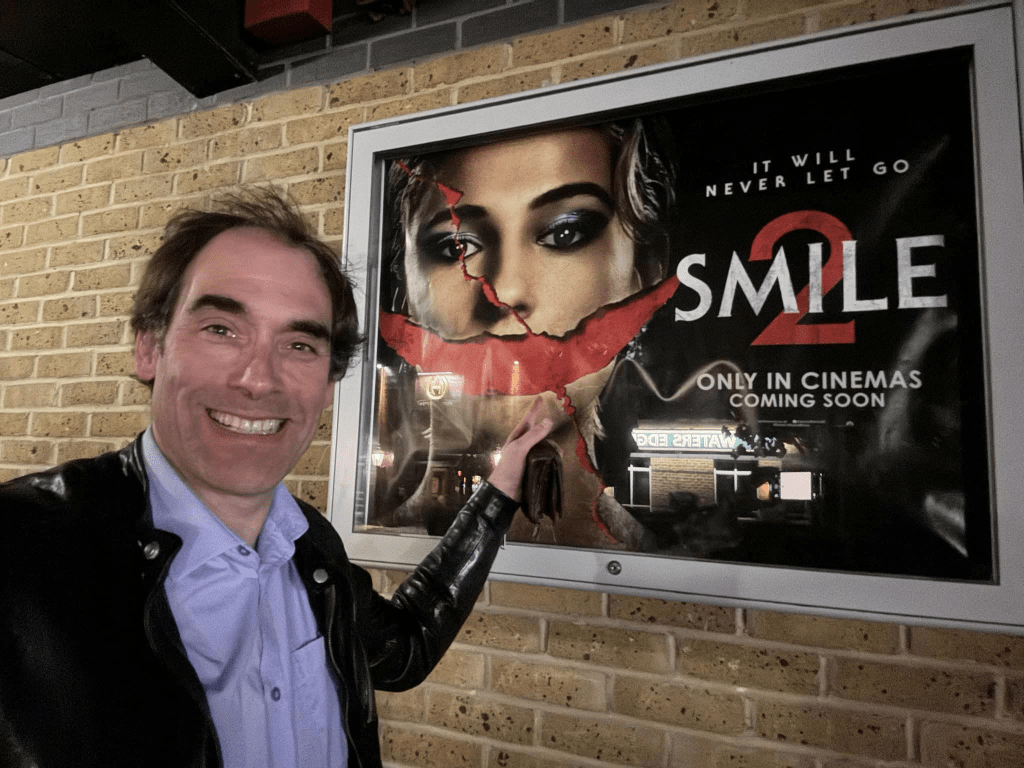
When I wrote my review of the original ‘Smile’ film in 2022, I felt more ambivalent about the horror movie than I did upon subsequent viewings, where it felt more multi-layered and textured than that initial viewing suggested. ‘Smile 2’ similarly did not strike me as being an especially imaginative or audacious follow up. But, on reflection, it deserves credit for taking what will presumably be a franchise to a different and impressive level in terms of the way it has moved away from dealing with the relationship between purported supernatural goings on and mental illness.
This sequel follows a similar path to that of ‘The Substance’ in terms of giving us a treatise on addiction, fame and physical disability as a lens through which we may interrogate the fragmentation of the abused or diseased self and the way that a supernatural foe may exploit that kind of relatable, even universal, vulnerability. In the ‘Smile’ films there is a parasitic dimension at work where a traumatic episode – in the first film it is the death of a mother and the guilt at not having been able to save her, here in the sequel it is the death of a partner in a car accident for which the protagonist bears some responsibility – that mutates into seeing and hearing episodes that appear real and visceral to them but which are absent to others.
And this is compounded by having characters appear who have been carefully constructed by the demon parasite to resemble the person concerned, only to be revealed to be fake when the ‘real’ person to whom they are ostensibly speaking contacts them via a phone call. The sign that someone is not who they say they are is when they manifest themselves with a gigantic, sinister smile on their face and then commit some kind of monstrous act of self-mutilation or immolation, and their suicide is then the means by which the demon is passed on., and for the cycle to perpetuate.
At every step of the way we have no more or less reason to doubt what Skye Riley (Naomi Scott) is experiencing – we see, hear, feel what she does, and her reactions are exactly as we could imagine responding if faced with something that we want to run away from but which always catches up with us. There are even scenes reminiscent of classic conspiracy theories, with maverick investigators turning up or sending messages and revealing what is happening to a traumatized Riley and then coming up with a plan to end the cycle. These scenes are borrowed from the likes of ‘The Parallax View’, ‘The Pelican Brief’ or ‘Enemy of the State’, but here the question of who we feel we can trust is intermingled with a supernatural narrative and adds to the sense of unease.
Presumably there will be further episodes in this series, and maybe some of them will go deeper than ‘Smile’ and ‘Smile 2’ in terms of giving us more of an insight into the mythology behind the smile possession. How did it start? Who or what is behind it? These first two films simply give us the formula, though it is frustrating and incongruous when at the end of both pictures we see the unmasked manifestation of the demon ‘behind the smile’, This will either endear audiences who are hoping for full-on, untrammelled external horror, or it may be deemed superfluous by those who have been so gripped by the realistic, grounded story that the incursion of horror tropes at the end undermines all that has come before. But this entry is a good dissection of modern fame and celebrity, and gives a whole new twist to the notion of ‘smile for the camera’.
 Chris Deacy
Leave a comment