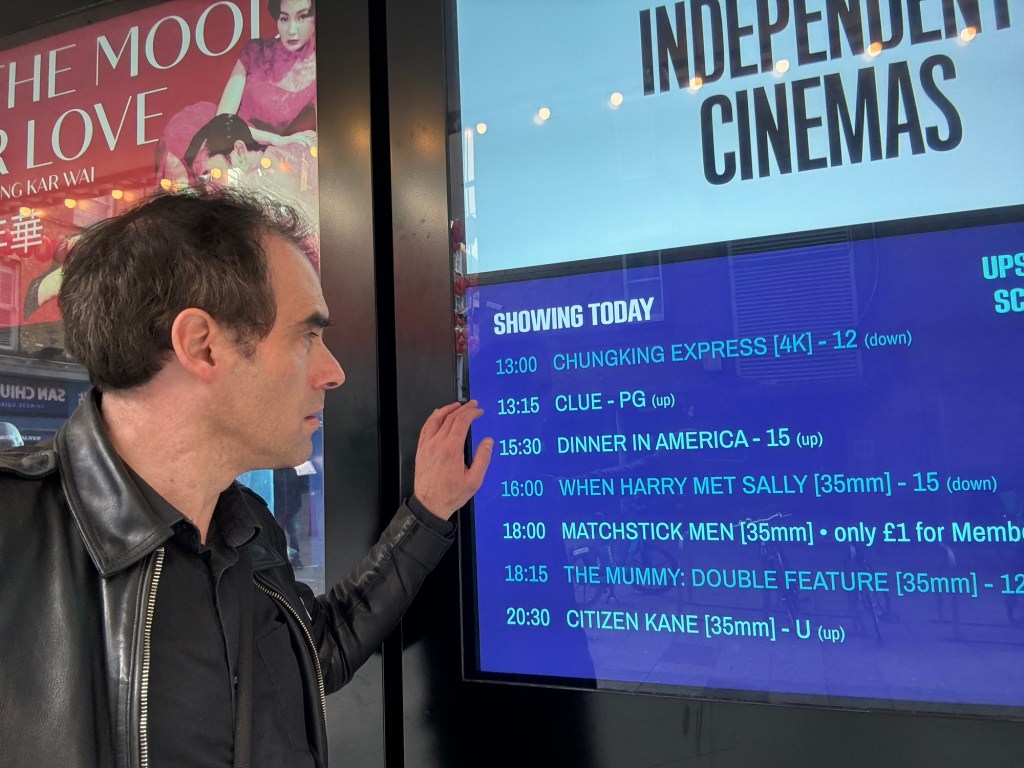
‘Clue’ is a curious blend of the stagey and the cinematic, in a beautifully rendered darkly comic murder mystery based on the Parker Brothers board game in which a cast of assembled strangers who, it transpires, all have something in common and all of whom have secrets to hide, are brought together in a mansion one autumnal night in New England. There are obvious nods to Agatha Christie and in its initial theatrical opening in December 1985 in the US there were three different endings with a different culprit and denouement, and at least we now have the luxury of being able to sample all three which have been combined in the version I saw at the Prince Charles Cinema in London nearly forty years on.
Characters wind up dead, but the reasons are only disclosed in the hectic, madcap ending(s) where Tim Curry’s butler runs around the Victorian Gothic mansion and at breakneck speed retraces all the steps – literally – and exposes ‘whodunit’. The fact that the culprit and their motives can so easily be amended is part of the tapestry of ‘Clue’ which functions philosophically as a puzzle which can be reordered, assembled differently and given a completely different structure predicated on everything that has come before it. It fits with how we all see the same events through a different lens and that our perceptions are invariably going to be inconsistent with the way somebody else has interpreted them.
We will each draw divergent conclusions on the basis of the pieces of the evidence with which we are acquainted. We see what we want to see, a premise that this film takes to the maximum by not simply giving us limited ‘data’ in order to facilitate our ability to reach the ‘objective’ destination of the murderer’s identity. Rather, we see how a slight shift here, a different interpretation there radically changes the outcome. In one of the three endings, indeed, we are shown multiple perpetrators for the multiple murders that stack up. But this also works to the film’s detriment as we do not ultimately feel any sense of investment in the culprit(s) who is/are merely cyphers in service to the exigencies of the plot.
These characters are ultimately based on a board game, and so we cannot really complain if there is a lack of durability or substance to their personalities and motives. If we were playing Cluedo, there would be a sense of randomness and interchangeability to the enterprise as murderers and motives are assigned according to the vicissitudes of the throw of a dice. The writer and director, Jonathan Lynn, cut his teeth in sophisticated British TV comedy ‘Yes, Minister’, and went on to direct ‘My Cousin Vinny’ in 1992 which has a more linear narrative, greater characterization and more assured comic timing, but ‘Clue’ is definitely worth the effort.


 Chris Deacy
Leave a comment