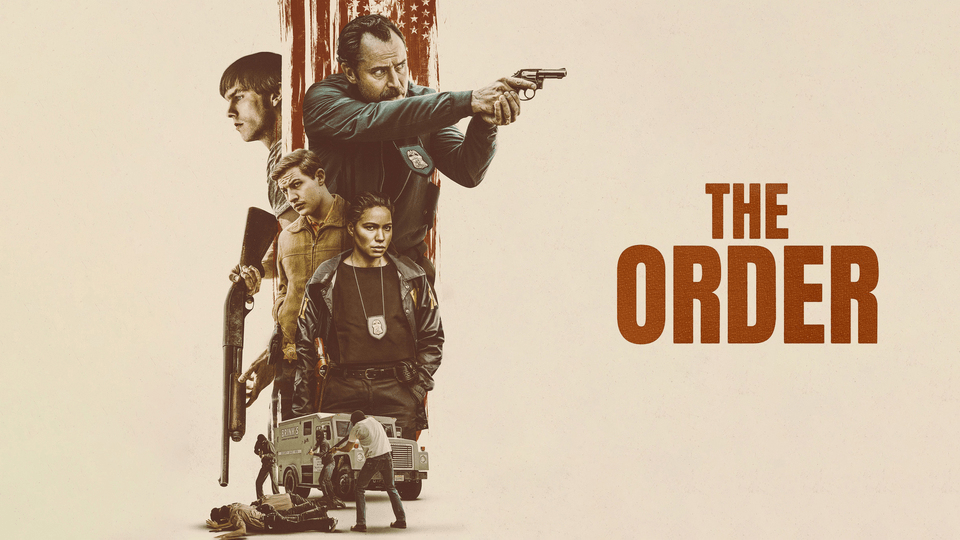
‘The Order’ is an intense, edge-of-your-seat thriller about a white supremacist terror group who in the early 1980s robbed banks in Idaho and surrounding states in order to advance their cause, and which is seen as the progenitor of the Oklahoma and 9/11 terrorist activities in subsequent years, as well as the 6 January 2021 Capitol attack. There is a David Koresh-style nature to the charismatic leader of the group, calling itself The Order, played by British actor Nicholas Hoult, who is pursued by Jude Law’s obsessive police officer for whom it is his personal priority to bring Bob Mathews (Hoult) to justice. We see the way family life is sacrosanct, but which takes a variety of different forms, with Law’s character, Terry Husk, geographically and emotionally alienated from his own family as he has invested all his energies into capturing his quarry, and we are given the sense that he has been fixated on similar assignments in the past.
The neo-Nazis themselves have families who either support, are pawns of, or who turn a blind eye to, the insurrections being planned, and who become potentially useful to the law officers as they try to close in on their prey. This is where the film gets into genuinely interesting territory as we are afforded a glimpse into why someone would seek to be caught up in a clandestine and ruthless cult whose own church rejects and ostracizes them, leading to more than one showdown between the local pastor and Mathews himself. They may share the same white supremacist objectives but their goals of achieving it are what distinguishes them, and ‘The Order’ contains many of the same dynamics and tensions as ‘Point Break’, again exploring ways in which policemen would try and infiltrate a community in order to break it apart, also using bank robberies as the catalyst for a cause that has spiritual connotations.
In Kathryn Bigelow’s pulsating, seminal ‘Point Break’ the cause is a Buddhist attempt to be at one with nature and to ride the ultimate wave, leading to extinction, while in ‘The Order’ the goal of white supremacy is not just ideological or political but a cause to live and – literally – die for. Mathews indeed may care for his wife, whom he recruited into his organization, but her inability to bear children means that he has to go outside the marital home to spawn a son who will carry on his crusade (as we discover, things don’t entirely go to plan). This is ultimately a tale of one generation, represented by the self-appointed messianic Mathews, who decide to use force in order to accelerate a process which was started by their forebears, and an older generation for whom politics is the cauldron by which their goals can be realized.



 Chris Deacy
Leave a comment