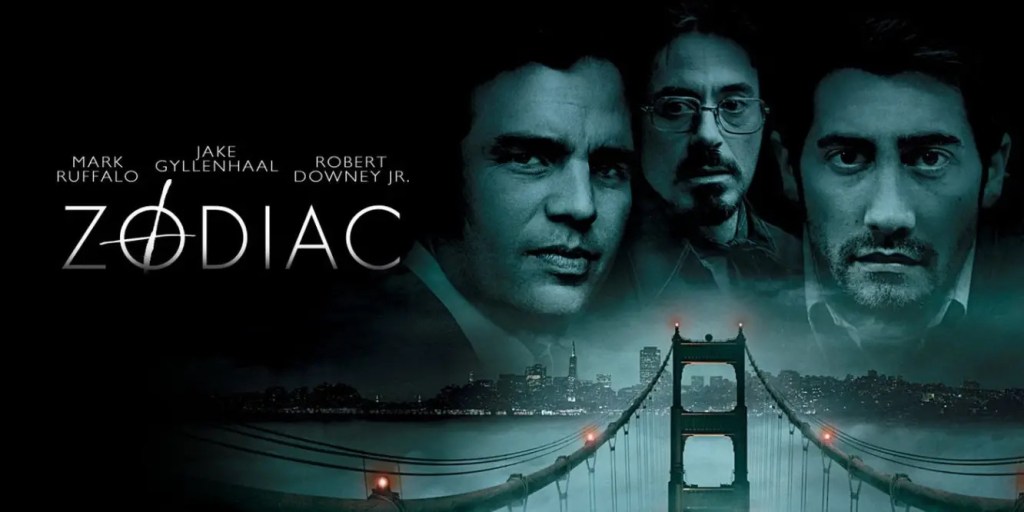
‘Zodiac’ is a chilling variant on the serial killer genre, helmed aptly by David Fincher whose ‘Se7en’, made over a decade earlier, itself reinvented the way we see the genre with its intellectual and theological undergirding and the preparedness to give us an ending which is stark and stomach-churning. Even if ‘Zodiac’ does not quite plumb those same depths it works so well because of the way it juxtaposes the journalistic fact-seeking element that we are used to seeing in police procedural or conspiracy thriller films along the lines of ‘All The President’s Men’ and more horror-based films about mass murderers.
Based on a true story, ‘Zodiac’ does not play out in the way that a fictional film would as it does not give us the sort of finality or closure that we have come to expect. Instead, what we have is a focus on the red herrings that inevitably accrue during an investigation, and which play out over more than two decades following the initial spate of killings by a serial killer in California calling himself the Zodiac and the time when the identity of the killer can finally be narrowed down with some level of reasonable certainty. This is a film about the process of the investigation and the way that different investigators ebb in and out of the case, and either sucks them in or causes them to step away, throughout the many years of tracking down an elusive killer, with multiple leads, most of which go nowhere.
The killer would go years without any activity and would then send cryptic messages via the ‘San Francisco Chronicle’. Ironically, the one person most obsessed with the case, and who saw it through, wearing out in the process the patience of the cops officially assigned, was the paper’s cartoonist Robert Graysmith (Jake Gyllenhaal) whose amateurish fixation outlasted everyone else. He sacrificed everything in the process, including his family, in order to pursue every conceivable lead, and ‘Zodiac’ is a tantalizingly good film precisely because of the way in which it puts front and centre not the killer and his victims but the highly relatable angle of the quest for answers and the way each of us can understand the way we can never let go of something until or unless we have managed to unearth every last thread of it.
What ‘Zodiac’ does so well is put forward the thesis, quite different from, say, ‘Se7en’, that serial killers may have normal, respectable day jobs and that the killings are not necessarily their modus operandi. Most serial killer films entail killers who murder for a living and if there is an occupation as such it consists of them preparing their next killings and trying to elude the officers who are on their tail. Here, the killer does not even have a set pattern, and his targets tend to be quite random. The fact that the killer disappears for such long stretches leads to the paradoxical scenario whereby the cartoonist is more committed to the outputs of the Zodiac than the Zodiac is himself. And, without spelling it out, the absence of killings over long periods comes across as dispiriting and frustrating for Graysmith because without any new evidence he has even fewer clues with which to narrow down his investigation.

 Chris Deacy
Leave a comment