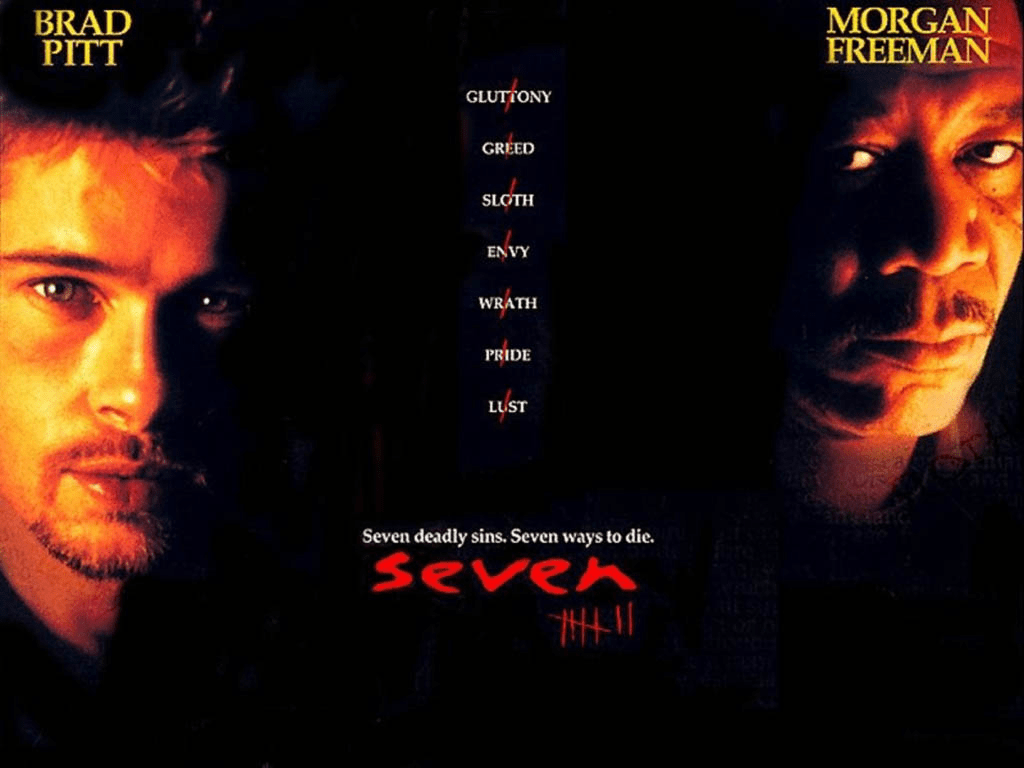
Se7en is a fascinating film to watch from the perspective of redemption, precisely because, in the spirit of film noir, redemption would appear to be the very ingredient missing in what is an unremittingly bleak and pessimistic ambience, and no indication that a better, more coherent and fulfilling future is possible. Yet this unsettling and audacious film which put Fincher on the map has a rich theological vein running through it whereby it is precisely in terms of encounter and confrontation with the downbeat ethos that is so endemic to ‘Se7en’ that ‘light’ can be thought to emanate within and through the ‘darkness’.
Set in an anonymous American city where it is always raining, what we have is a reimagining of the detective genre where the culprit is a serial killer who slays his victims according to the seven deadly sins. Detective Somerset (Morgan Freeman) is the moral centre of this drama. No matter how irredeemable the world may be, the world-weary Somerset has not yet given up on it, and indeed quotes Ernest Hemingway to this end that ‘“The world is a fine place, and worth fighting for.” I agree with the second part.’ ‘Se7en’ thus confronts us with a challenge, one of acknowledging that, although it may be a largely futile and often hopeless endeavour, the possibility of redemptive grace still exists, where there is a recognition that evil – though pervasive – is not inherently insurmountable.
Fincher digs deep into literary history, as when as part of the investigation into the serial killings Somerset is drawn to the writings of Aquinas and Milton, at one point quoting from Paradise Lost – ‘Long is the way and hard that out of Hell leads up to light.’ Despite the bleakness of the film’s climax, which in some respects makes Somerset’s junior partner Detective Mills’ (Brad Pitt) path to redemption far more difficult, in that he plays right into the hands of the killer in the brutal denouement, it is not without irony that the last quarter or so of the film is set in bright daylight and is the point at which Somerset, on what he had set out to be his last day on the job, has the wherewithal not to succumb to the darkness.
‘Se7en’ is that rare gem, therefore, in its re-evaluation of noir tropes by way of giving us two things in tandem – darkness and light, and the clear proposition that they are not mutual opposites. In line with a more Manichean or Zoroastrian frame of reference, the only route through which the light can be apprehended and imbibed is by its confrontation with its binary opposite. The fact that the film’s set design has the look of a 1940s noir movie is also key to its success, as this is very much Fincher’s stock-in-trade, as we saw with ‘Fight Club’, which also played on motifs relating to rebirth and redemption in the context of physical violence and nihilism, and ‘Zodiac’ which returned to the serial killer genre but chose to make the focus that of the detectives or lay people obsessed with the case over and above the machinations or even the identity of the serial killer themselves.
In ‘Zodiac’ we are never sure whether the killer is aware of the work of the detectives trying to apprehend him, and whether they may be implicated in his scheme, and in the same way ‘Se7en’ does the bold job of showing how in confessing to the police detectives who are assigned to the case their very souls are at stake. In confessing to the crimes, John Doe (Kevin Spacey) is indeed handing over the burden of responsibility to Mills and Somerset, and ensuring that the way they act is crucial to whether his killings have meaning, purpose and indeed whether he is vindicated rather than punished through his act of confession.
The other irony is that Somerset realizes that in capturing his quarry he cannot retire as he had first hoped, but must carry on in the thankless role of keeping the world ticking along, as in the metronome in his apartment, and in what is essentially a lone crusade against the forces of evil, one which has penetrated Somerset but has not yet contaminated him.


 Chris Deacy
Leave a comment