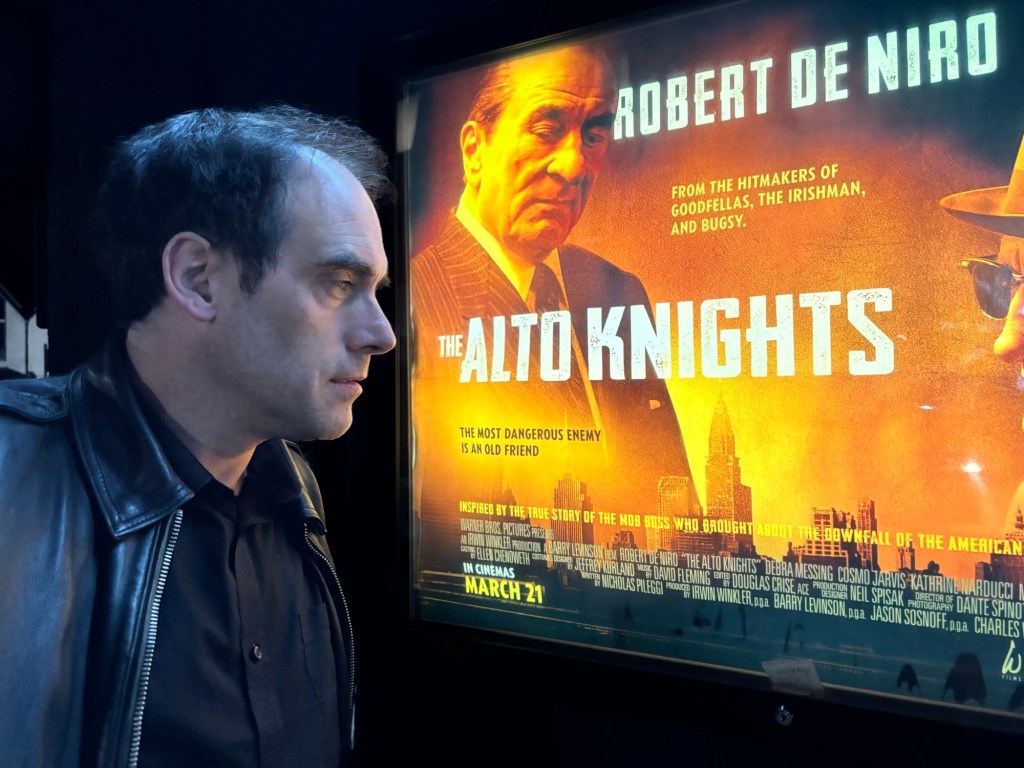
‘The Alto Knights’ is something of a retread for director Barry Levinson whose ‘Bugsy’ in 1991 was heavily Oscar-nominated. Here, Robert De Niro plays dual roles as mob bosses Frank Costello and Vito Genovese, There is of course a certain thrill in watching De Niro appear in the genre in which he excels – following his forays into the genre over the years in the likes of Scorsese’s ‘Mean Streets’, ‘Goodfellas’, ‘Casino’ and ‘The Irishman’, as well as Brian De Palma’s ‘The Untouchables’. Yet, ‘The Alto Knights’ is a listless and plodding rendering, in which everyone appears to be going through the motions, including having a voice-over from De Niro which, while sharp and nuanced in ‘Casino’, is here delivered in a mumbling, stumbling growl.
De Niro seems to have a low energy level, and although he is on screen for most of the film’s duration he doesn’t really get beneath either of his characters who have all the tics and mannerisms of a wise guy but there is no effort to give the viewer a way into the world of 1950s gangsters in a way that De Niro himself did so well in his directorial debut ‘A Bronx Tale’ in 1994 which brought an outsider’s perspective into the familiar world (to De Niro) of the Mafia. This flaccid two-hander really has De Niro going through the motions and struggling to immerse himself in either Frank or Vito.
The prosthetics are not even all that great, with Vito distinguished from Frank by the clearly very fake nose he is wearing – we can even see the joins – and this film comes close to caricature as it depicts Vito’s penchant for capricious acts of retribution against anyone who stands up to him (except, it would appear, his rather discontented wife). Vito and Frank were once childhood friends, but they are now two squabbling old men with competing visions and agendas, which frequently clash. It doesn’t help that Vito appears to be an impersonation of Joe Pesci from ‘Goodfellas’ and ‘Casino’, and De Niro plays Vito as a volatile, petty, vindictive man who lashes out with very little provocation.
There is thus the irony that De Niro is playing two characters, but one of them is modelled on another veteran actor who, if the film had been made earlier, might have been a good fit for Pesci who has a penchant for petulant, hysterical characters for whom violence is an extension of language and, simply, conversation taken to a more extreme level. The feel of the film is also tonally off, with De Niro sometimes playing Frank as a talking head, at other times in unseen voiceover, and at other times Levinson shows period footage from TV or photographs to furnish his reconstruction of the warring factions of a bygone age.
It feels like what should have been an elegiac epic story has been whittled down to a succession of showdowns and recriminations which are at times engaging, even electrifying, but just come across on the whole as stale and vanilla repeats of something we have seen done much better before by De Niro when he (sensibly) settled on playing just the one role.

 Chris Deacy
Leave a comment