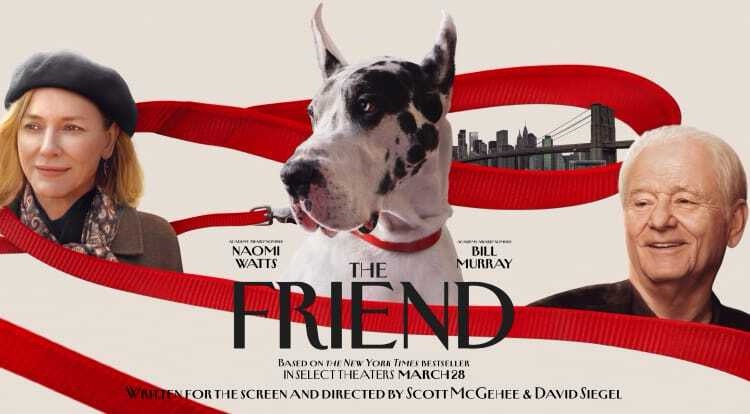
‘The Friend’ is a slow-burning, dramatically rich study of the impact of the death of a loved one, especially when it is unexpected, on the lives of those left behind – and the lateral and surreal ways in which resolution and catharsis can be accomplished. Where ‘The Penguin Lessons’ offered us therapy by means of a rescued penguin from Uruguay who restores the humanity of the man who (albeit reluctantly) rescued it from an oil slick, so here Iris (Naomi Watts) takes on the laborious role of adopting the Great Dane, Apollo, of her friend, muse and lover Walter (Bill Murray) following his suicide.
Apollo even appears in the main credits, played by Bing, with the right amount of dreary, doleful melancholy as he struggles to adapt to a world without his master who used to read him his poetry and prose. This may be the first time in a film that a dog’s mental health and wellbeing has been the cornerstone of the narrative, and it is quite an impressive feat as the film also takes time to examine the toll that loss and death have on Iris as well as Walter’s three wives and his (for many years) estranged daughter.
Iris lives in a rent-controlled apartment where dogs are prohibited, and Walter hadn’t sought to tell her about his wishes that, following his death, Iris should take care of his beloved Dane. Iris, a literary professor, risks homelessness in order to accommodate Walter’s apparent wishes, though it isn’t long before Iris herself, a self-confessed dog-aphobe, takes Apollo under her wing and soon realizes that the restorative and therapeutic properties work both ways, and that Apollo is saving her as much as she is saving him.
The film also shows how, in bonding with Apollo, Iris’ own equivalent of writer’s block is able to be treated, as her efforts at writing up Walter’s papers and diaries in the aftermath of his suicide do not exactly work to the schedule agreed with her publisher. Walter’s death and the arrival in her life of Apollo give Iris the space she didn’t realize she needed to be able to write a creative novel of her own. The film is full of classroom scenes in which Iris is trying to bring out the literary potential in her young students while her own writing journey is stuck in a rut.
Through Apollo, however, she now has a story of her own to tell, and she even manages to square the circle by resurrecting the deceased Walter so that he can appear in her story from beyond the grave to offer a commentary on the meaning and impact of his own life and how his post-death status provides unexpected opportunities for channelling the anger and bitterness that the void created by his death has brought.
This incursion into meta territory is another of the more unusual aspects of the film which, in lesser hands, could have been a misstep. After all, what we are afforded is a traumatised ex-lover berating and holding to account the man who has (already) taken his life. But fiction can be redemptive, and life can be stranger than fiction. This ‘odd couple’ drama has pathos and comedy in abundance.


 Chris Deacy
Leave a comment