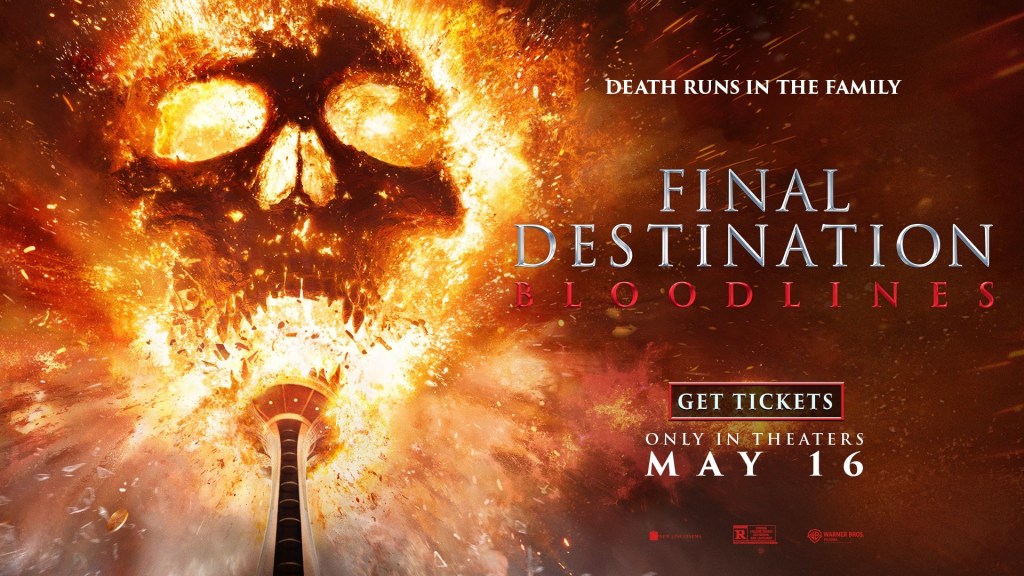
The ‘Final Destination’ series of films work because at their heart is the way they dramatize the basic human fear of death and the question of free will. How much agency do we have in living, and can the Grim Reaper be kept at bay when, in a variation on the Calvinistic understanding of pre-destination, it has been predetermined that some people have been predestined or elected to eternal salvation while the rest are liable to eternal damnation.
In these films, creative ways are found for death to seize control of the narrative and ensure the manner and order in which our destinies lie, and, they warn us, we have no autonomy to arrest the process. ‘Bloodlines’ takes the franchise in a new direction by serving up multiple generations of a family who are destined to die following the collapse of a high-storey restaurant in 1968 as one of the protagonists suffers a premonition as to the nature of the death and the order in which it is to be carried out.
Fifty five years later, in the modern day, the woman’s granddaughter suffers the same premonition and learns the truth of what death has in store. The deaths always take the form of seemingly prosaic forms, such as a barbeque, or a lawn mower, a leaf blower or a garbage truck. Death traps are set up, only for a group of eager and cocky teenagers to attempt to deconstruct the formula and try and cheat the inevitable. On the one hand these films set out to titillate and scare us by showing how death can take ever barbaric and capricious forms (here an MRI machine becomes a literally magnetic agent of death), but they also work as treatises on metaphysical questions relating to free will and mortality.
Death appears to have spared some people, prompting a theological discussion around the exigencies of grace, but here death is portrayed as a cruel and barbaric instrument of doom, and even anthropomorphized as a ‘he’. This is really an origin(s) story which even goes so far as to mythologize death, and there is a moving sequence involving the late actor Tony Todd, a familiar figure in this franchise, who was dying of cancer when he turned in his cameo, and whose message, familiar from the Book of Ecclesiastes, to make the most of life, and to savour every last moment as it may be our last, brings a dimension of pathos and gravitas to a franchise which has largely been about the trivialization and exploitation of our fear of our impending end.
Coupled with the razor-sharp focus on the dysfunctional family at this film’s heart, who embrace their differences and establish that, when our lives are literally hanging in the balance, blood is thicker than water, this is a worthy edition to the now 25 year old series. It is the viewing of a family with more than its fair share of secrets and lies that comes together to valiantly reshape the machinations of the universe that gives this film a heart and a relatability that some of the previous entries could only have dreamed of.
 Chris Deacy
Leave a comment