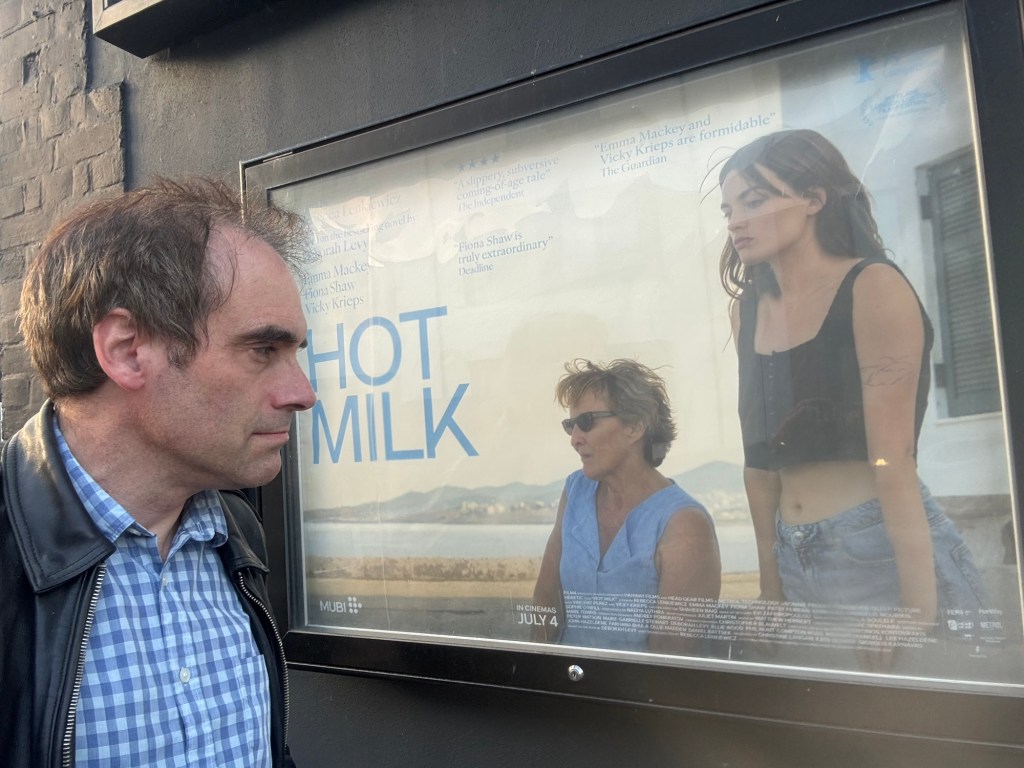
‘Hot Milk’ is a delirious, elliptical film that grapples with questions of memory, perception, and the elusive line between reality and dream. It centres on a volatile mother-daughter relationship, set against the disorienting backdrop of a sun-bleached Spanish town, where everything feels slightly skewed and dislocated.
The story, based on the novel by Deborah Levy, explores how place and perspective shape our understanding of truth. Sofia (Emma Mackey) has put her PhD on hold to care for her mother Rose (Fiona Shaw), who has been wheelchair-bound for 20 years. But as the film progresses, Sofia begins to question whether her mother’s disability is as absolute as she claims… or whether it’s been exaggerated to ensure Sofia’s unwavering attention. Is Rose truly in need, or is she using her condition to exert control?
There are moments when Sofia thinks she sees her mother walk, but nothing is confirmed. The film plays with ambiguity, and we’re never certain what’s real and what might be a fleeting hallucination or suppressed memory. This tension recalls in this respect ‘The Prince of Tides’, where characters slowly unearth buried trauma to explain present-day afflictions. Here too, the implication is that illness might not be solely physical.
The atmosphere is dreamlike – at times claustrophobic, at others almost mythic. A poem early on suggests that ‘a journey to hell can be wonderful’, reinforcing the idea that perspective determines our understanding of events. There’s an embroidered word that’s meant to read ‘beloved’, but instead seems to say ‘beheaded’ – a chilling metaphor for the dualities at play throughout the film, such as that between love and control, protection and manipulation and illness and performance.
Fiona Shaw is enigmatic as Rose – by turns vulnerable, controlling, mysterious and pitiful. Her insistence that Sofia must not see her estranged father only fuels Sofia’s defiance. Their codependent dynamic is echoed in Sofia’s yearning for intimacy, which she seeks in a series of increasingly ambiguous encounters, including with a seductive stranger whose own role in the story is unclear.
The Spanish doctor treating Rose may be helping, or merely enabling the dysfunction. He seems part charlatan, part healer, and represents yet another unreliable figure in a world full of slippery truths.
The film builds toward an audacious, open-ended finale. A character’s fate hangs in the balance – literally life or death – but we’re not told which. It’s frustrating, but also fitting as ‘Hot Milk’ is a story about the instability of narrative, about how trauma distorts our internal landscapes., and it suggests that closure is something you find within rather than from external resolution.
The film echoes ‘Death in Venice’, ‘The Prince of Tides’, even ‘Whatever Happened to Baby Jane?’, but ultimately it stands apart. It’s a psychological fever dream wrapped in sunlight and shadow. Not everything works, and the ending may leave us feeling cheated, but it lingers, hauntingly, like the memory of something half-forgotten and maybe even quasi-invented.




 Chris Deacy
Leave a comment