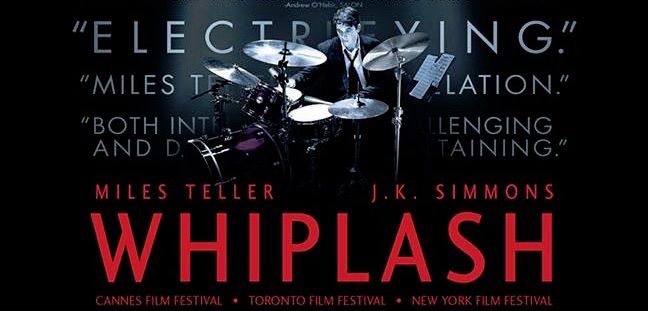
‘Whiplash’ is a film about obsession – how far someone will go in the name of commitment, and the complicated, often volatile relationship between teacher and pupil. How far can you push someone’s drive before it becomes abuse? Set in a fiercely competitive music school, J.K. Simmons (in his Oscar-winning role) plays a sadistic instructor who throws furniture and bullies his students to breaking point. His character evokes the brutal discipline of a military commander, believing that only by pushing his students beyond endurance can they achieve greatness.
Whatever 19-year-old Andrew (played by Miles Teller) does, it’s never enough. The film draws on the legend of Charlie Parker, who had a cymbal thrown at him for poor timing—a story that may or may not be true, but raises timeless questions about whether suffering is a necessary price for excellence in art. Andrew’s personal life suffers. He fears romantic involvement – he worries that a girlfriend would resent the time he devotes to drumming. It’s a tragic echo of ‘The Remains of the Day’, where the protagonist realizes too late what he’s lost in the pursuit of professional perfection.
Director Damien Chazelle, who would go on to win an Oscar for ‘La La Land’, builds an incredible tempo throughout, reminiscent of Bob Fosse’s ‘All That Jazz’ – another story of creative brilliance haunted by excess. ‘Whiplash’ also recalls ‘Good Will Hunting’ in its exploration of the power dynamic between student and teacher, and whether the student might eventually surpass the master. Powell and Pressburger’s ‘The Red Shoes’ is another relevant reference point, asking: what does it mean to die for your art?
There are also questions of trust and manipulation: what happens when you try to impress a teacher who will never give you the satisfaction of approval? In one scene, Simmons’ character plays piano in a nightclub. It’s a perfectly fine performance—but nothing extraordinary. It raises the uncomfortable question: are these teachers less talented than the students they belittle?
The film takes on new resonance in the post-#MeToo era. Ironically, jazz – celebrated for its improvisation and freedom – is here portrayed as something rigid, militarized, exacting. This is alpha masculinity at its worst. It will be interesting to see how the upcoming ‘Devil Wears Prada’ sequel handles a similar dynamic; even Meryl Streep’s icy editor showed flashes of grace.

 Chris Deacy
Leave a comment