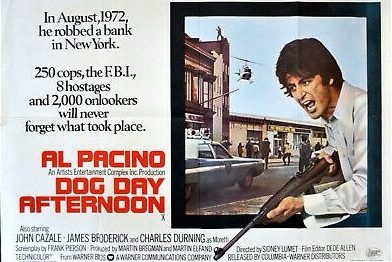
‘Dog Day Afternoon’ is a fascinating, ahead-of-its-time film that blends crime drama with social commentary, emotional vulnerability, and dark comedy. Based on a real event, it follows a Vietnam War veteran (played by Al Pacino) who attempts to rob a bank in order to fund his lover’s gender-affirming surgery – a premise that would be groundbreaking even today, let alone in the 1970s.
While technically a heist film, ‘Dog Day Afternoon’ constantly subverts the genre’s expectations. Pacino’s character, Sonny, enters the bank with a loose plan and some basic knowledge of how these things are supposed to go. But everything begins to unravel quickly – there’s barely any money in the safe, his accomplice (played with heartbreaking quietness by John Cazale) is unstable, and the police arrive far earlier than expected. What follows is a masterclass in tension, character development, and slow-motion unravelling.
Yet, despite the escalating chaos, the film never loses its human core. Sonny becomes a strangely sympathetic figure – not just to the audience, but to the bank’s female employees, who gradually warm to his nervous charm and visible humanity. As the standoff drags on, he forms unexpected bonds with the hostages, who at times seem to understand and even support his motivations more than the outside world does.
Set just a few years after the Attica prison uprising, the film resonates with post-1960s distrust of authority. Crowds gather outside the bank, many of them cheering Sonny on. The police, though not exactly villainous, are depicted as part of a rigid, impersonal system that Sonny cannot navigate. He’s a man constantly on the edge – of society, of sanity, of redemption – and Pacino plays him with raw vulnerability and manic energy.
There are shades of ‘Unforgiven’ in how the film interrogates the hero/antihero binary. Sonny isn’t just a desperate man; he’s also a reflection of a broader, fractured society – one in which people are constantly forced to choose between survival and dignity. The film crosscuts between the tense events inside the bank and Sonny’s complicated domestic life: his estranged wife and children, his same-sex partner, and even his bewildered mother, who turns up in a futile attempt to plead for calm.
Director Sidney Lumet gives the city itself a character-like presence – gritty, overheated, chaotic. The setting is essential: this isn’t just a personal crisis, it’s a societal one. The absurdity of the situation is heightened by moments of dark humour – such as boyfriends and husbands of the hostages calling the bank to ask when their partners will be home, as if this were just an inconvenience rather than a life-or-death scenario.
Sonny evokes sympathy, but he also knows he’s past the point of no return. What makes ‘Dog Day Afternoon’ so powerful is its refusal to simplify anyone. Even the bank staff begin to understand him – not so much to condone his actions, but to recognize his desperation and humanity. It’s a sociologically rich drama with surprising empathy for every person caught in the madness of the moment.
In the end, ‘Dog Day Afternoon’ isn’t just about a botched robbery. It’s about identity, loyalty, love, and the way systems break people down. And in Pacino’s performance, we see a man pulled apart by forces both internal and external, and comprises one of the great portraits of unravelling in American cinema.

 Chris Deacy
Leave a comment