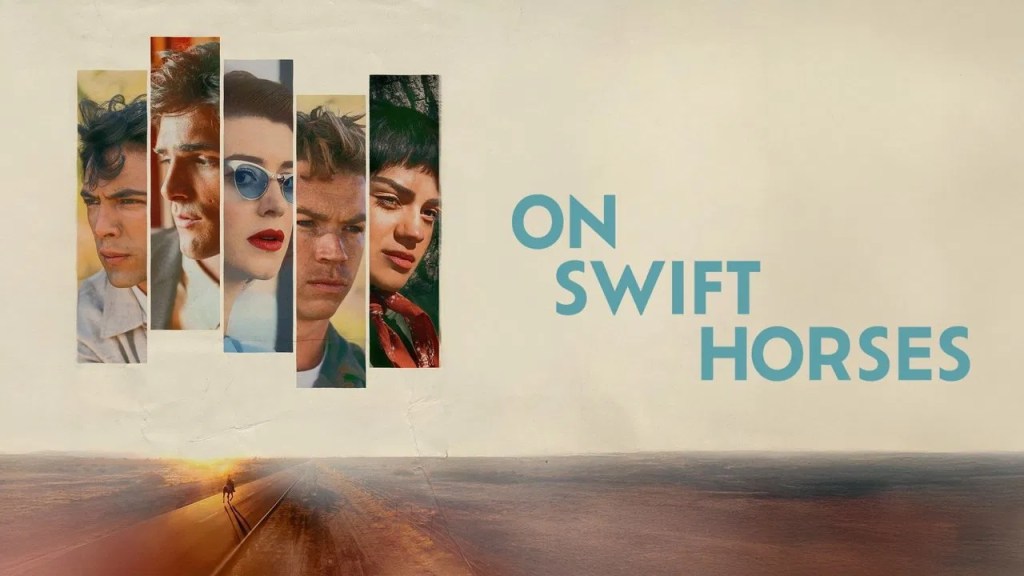
‘On Swift Horses’ is a 1950s-set drama about relationships, distraction, and desire, with a discernibly queer frame of reference. It carefully evokes a time when discretion and propriety were paramount, and it lingers on how people navigated love and identity within the strictures of postwar society. The film often seems intent on reminding us that this is a portrait of a different world, even as it hints at continuities with our own.
One of the most striking devices is its use of music: contemporary tracks are blended with period songs, creating a modern commentary on mid-century settings. The result is a kind of postwar melodrama filtered through a contemporary lens, recalling ‘A Streetcar Named Desire’ in its exploration of two brothers with contrasting temperaments and capacities for love and harm. At its heart, the film asks whether the underlying tensions of that era – around romance, sexuality, and identity – were really so different from today.
Gambling and horse racing provide a recurring motif, linking questions of risk, chance, and desire. But despite its evocative setting, the film is less concerned with the mechanics of plot than with mood and atmosphere. In this, it recalls the work of directors like Claire Denis, whose films shimmer with surfaces and suggestion, or Douglas Sirk in the 1950s, who depicted forbidden relationships that could barely be spoken of, let alone realised.
Visually, ‘On Swift Horses’ is sumptuous, full of gleaming period detail. Yet for all its opulence, the storytelling often remains on the surface. There are twin narratives – two same-sex relationships, one female, one male – that gesture toward duality, but the film never fully develops them beyond their symbolic weight. Secrets and lies are central, as is the need for concealment, but these are treated more as motifs than as lived experiences.
The result is a film that conveys the shimmer of transgression without digging deeply into its cost. Beautifully mounted and filled with possibilities, ‘On Swift Horses’ offers a strikingly modern gloss on mid-century repression, but it leaves us admiring the surfaces rather than feeling the depth beneath them.



 Chris Deacy
Leave a comment