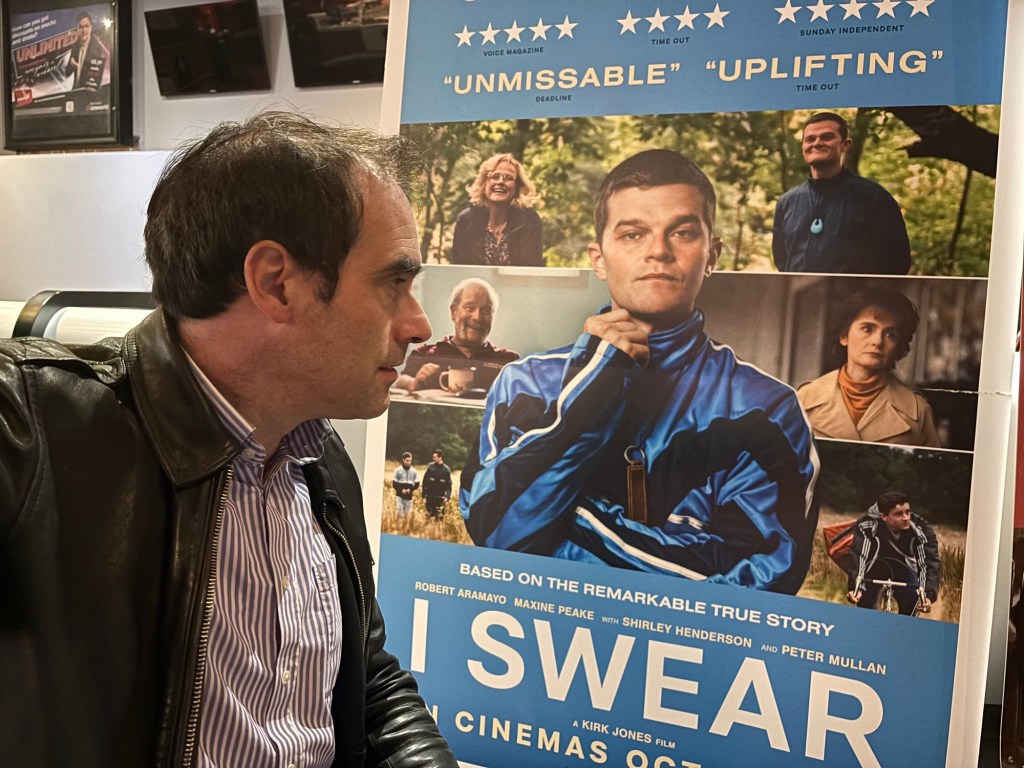
‘I Swear’ is a deeply moving film that charts the life of a man living with Tourette’s syndrome in Scotland. It begins in the 1980s with John, a boy just starting secondary school, who develops uncontrollable tics and verbal outbursts. Misunderstood and reprimanded, he is eventually expelled, setting off rifts within his family. His father leaves, his mother struggles, and no one knows how to handle him.
The film then jumps forward to 1996, with John now a young man. His condition has worsened, leading to blackly comic, sometimes volatile situations: shouting obscenities in a supermarket, blurting out offensive phrases in front of the police, or saying the exact opposite of what he means. Fights break out, but John is never portrayed as malicious – instead, he’s shown to be honest, reliable, and full of heart, with the real problem lying in society’s failure to understand his condition.
The framing device is powerful: the story opens in 2019 with John about to receive an MBE from the Queen. In a silent room, he can’t stop himself from swearing – a moment that perfectly captures the tension between decorum and uncontrollable impulse. By starting with his triumph, the film makes the long journey there feel all the more remarkable.
Performances are excellent, with Peter Mullan, Shirley Henderson, and Maxine Peake all adding depth and compassion. One of the most affecting scenes shows John’s bewildered mother making him sit in front of the fireplace to eat, punishing him for spitting out food during an outburst. She loves him, but sees him as an embarrassment, a source of shame, and is a powerful reminder of how little Tourette’s was understood in that era.
What makes the film so engrossing is its refusal to patronise. Yes, it is often funny, as when John blurts out shocking phrases at a job interview, but the humour never feels cruel. Instead, the incongruity of the condition is presented with tenderness and respect. A particularly moving scene arrives late in the film, when John meets another person with Tourette’s for the first time: a young girl. Sitting together in a car, the two swear uncontrollably, and the shared release is cathartic, even joyful.
The film captures the social stigma of the 1980s and 1990s, when Tourette’s was rarely discussed and those with the condition were often ostracized. Watching it now, only a few decades later, feels like looking back on another world. ‘I Swear’ may not be an easy watch for everyone – the language is coarse, on par with 2024’s ‘Wicked Little Letters’ – but it is tender, engrossing, and unflinching. Ultimately, it is less about Tourette’s as a disability than about the failure of others to understand it, and the triumph of one man in turning shame into advocacy, and alienation into acceptance.

 Chris Deacy
Leave a comment