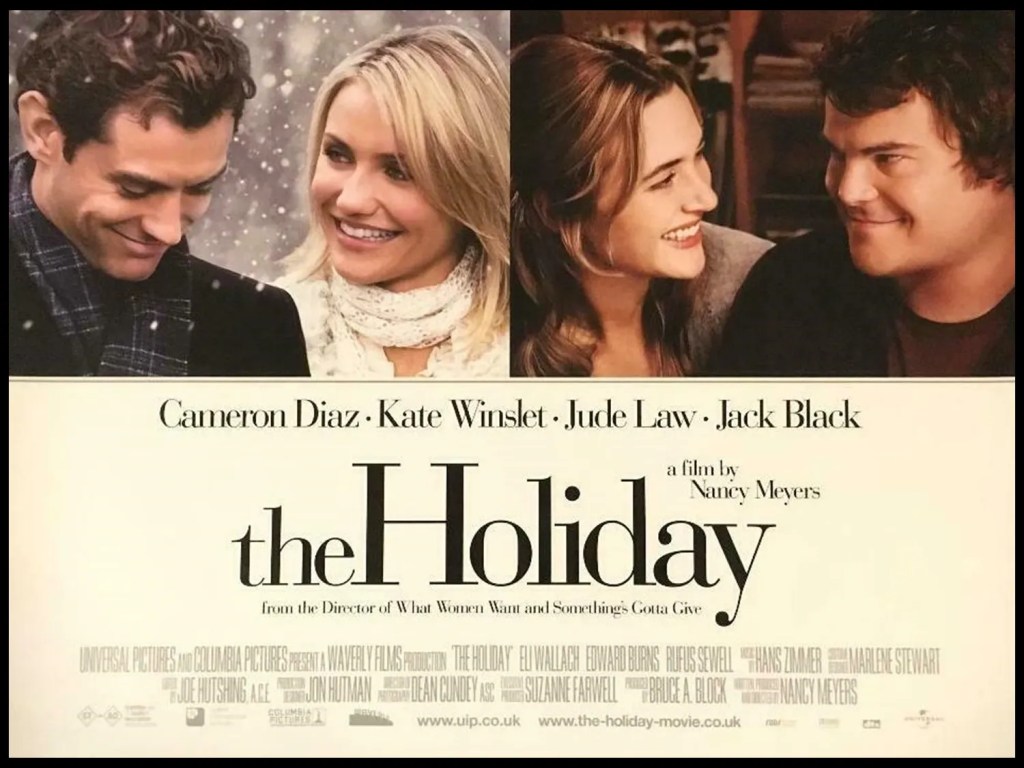
‘The Holiday’ dovetails well as far as Christmas films go with ‘Love Actually’, with Kate Winslet’s schmaltzy voiceovers channelling Hugh Grant’s seasonal dictums from three years earlier and a similar blend of characters going through a variety of seasonal dysfunctions all coalescing and crisscrossing with one another. Here, two unlucky-in-love women, English journalist Iris (Kate Winslet) and Los Angeles marketing whiz Amanda (Cameron Diaz), from different sides of the Atlantic, house swap and find that new relationship entanglements from across the pond give them the hope that there are good men out there after all and that a little bit of Christmas magic can go a long way to mend a broken heart.
But it is the friendship between Iris and 90-something Hollywood screenwriter Arthur (Eli Wallach) that is the most unexpected and poignant aspect of this film which has its own dose of Tinseltown magic to impart. Wallach brings decades of Hollywood history to his role and in teaching Iris about classic movies and his reluctance to be honoured by an industry that has, perhaps, lost its soul, ‘The Holiday’ more than compensates for the considerable layers of platitudes and slush that informs its basic premise.
By the end both women have men that they deserve, rather than the sleezebags that sent them packing in the first place, though along the way we might feel that, as one reviewer has put it, Diaz has wandered into a Richard Curtis British comedy and Winslet has walked into a Nora Ephron American romcom. The mechanics of the formula are fully on display as when we have Diaz’s character someone who makes movie ads and keeps seeing her own life in fantasy sequences reduced to a Hollywood trailer, and also when Arthur tells Iris that she is the leading lady of her own narrative but is stuck in the personae of the ‘best friend’.
But ‘The Holiday’ also gives us the very fantasy it is deconstructing, making this a richer, more multifaceted film than we first expect, even if the target audience is not really going to be too caught up in a treatise on Hollywood’s decline. The score here by Hans Zimmer — in which the script self-reflexively identifies him at one point — is mawkish but touching, especially in the scenes where Jack Black’s shy film composer Miles provides a musical score for Arthur and Iris and we see in their reactions just how the textured score is a perfect fit for their idiosyncratic characters.
 Chris Deacy
Leave a comment