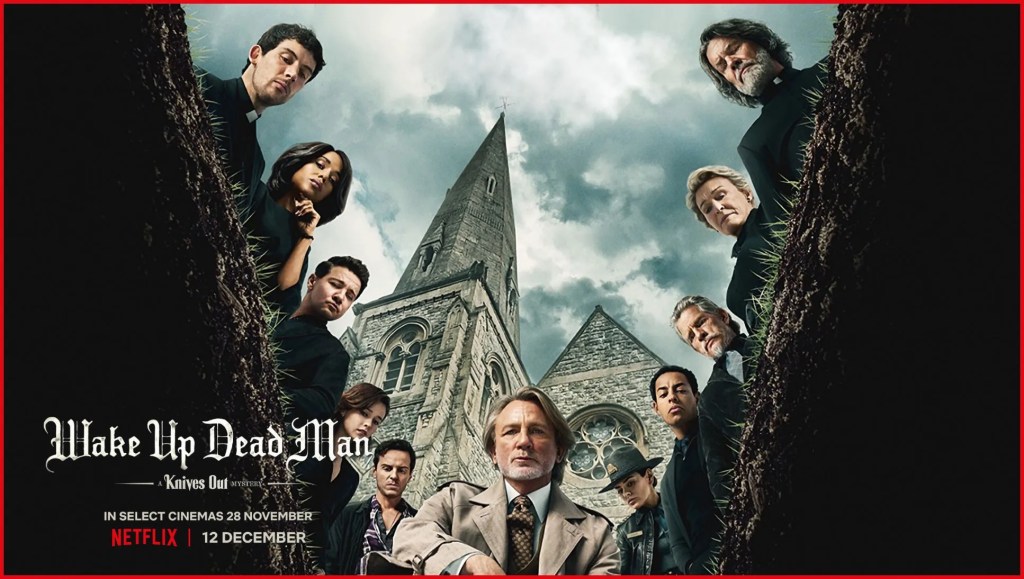
‘Wake Up Dead Man’ is a masterclass in the whodunnit (or should that be the whydunnit) genre – a film packed with red herrings, narrative trapdoors, and enough misdirection to keep even the sharpest viewer guessing. It’s one of those mysteries you could watch again and again and still struggle to see how every piece of the puzzle fits together.
The story unfolds in the remote, snow-covered New York town of Chimney Rock – a setting reminiscent of the original ‘Knives Out’ in 2019 in its autumnal hues where a murder sends a tight-knit community into a frenzy. Glenn Close delivers a stellar, scene-stealing performance as a devout, deeply secretive housekeeper who knows exactly when to panic, when to appear when you least expect, and when to spark hysteria.
Josh O’Connor takes the lead as Father Duplenticy, a disgraced priest and former boxer whose punches land far more easily than his sermons. As punishment, he’s sent to this troubled parish – one steeped in vice and moral rot. Josh Brolin plays the resident priest, the self-titled Monsignor Jefferson Wicks – a drunken, foul-mouthed bully who weaponizes confession and abuses his authority with relish. His tirades sound more like hate speech than homilies, and the misuse of pastoral power becomes a disturbing theme.
When a pivotal figure is found dead, Duplenticy becomes an immediate suspect, caught with blood literally on his hands. And into this fractured community strides Daniel Craig’s Benoit Blanc, still sporting his gloriously eccentric Southern drawl, playing detective like a philosopher-sleuth. He may appear bumbling, but he’s six steps ahead of everyone else.
Like the first ‘Knives Out’, greed looms large. There’s a recently lost patriarch, a squabbling circle of potential heirs, and parishioners who hide their sins behind piety. Yet this film takes a bolder turn: it engages directly with the theological – resurrection, miracles, faith distorted into something violent and self-serving. In a genuinely audacious twist, someone rises from the dead. Christianity’s defining claim becomes murder-mystery complication.
The film becomes a fascinating duel: a turbulent priest, driven by passion and belief, set against Blanc’s cold logic and rational deduction. One sees divine intervention; the other sees evidence. What happens when both might be right?
The flashback presence of Jefferson Wicks, more messianic than moral, gives the drama a biblical texture – discipleship, betrayal, and sacrifice played out in a tinderbox parish. These parishioners are no flock; they are wolves who will kill their own shepherd if pushed.
This is a locked-church mystery where, impossibly, everyone saw the priest alive – Duplenticy holding a six-foot cross, the rest of the congregation sitting in the pews – at the exact moment he was murdered. The clues point everywhere and nowhere at once. And beneath the twists runs a deeper question: if a messianic figure walked among us today – flawed, turbulent (even megalomanical), misunderstood – would anyone see him? Or would he be silenced again?
‘Wake Up Dead Man’ becomes a startling microcosm of modern America – faith manipulated for personal gain, truth reshaped to fit ideology, and justice pursued only when convenient. It also flips the dynamic of the genre – O’Connor’s priest sometimes feels like Blanc’s rival investigator, despite himself being prime suspect, with Blanc himself drifting to the margins as chaos builds.
The eventual reveal is satisfying – but the journey is even more thrilling, wild, and theologically rich. This isn’t just a whodunnit. It’s a parable about belief, sin, and the sacrifices we make – or refuse to make – for the truth.
 Chris Deacy
Leave a comment