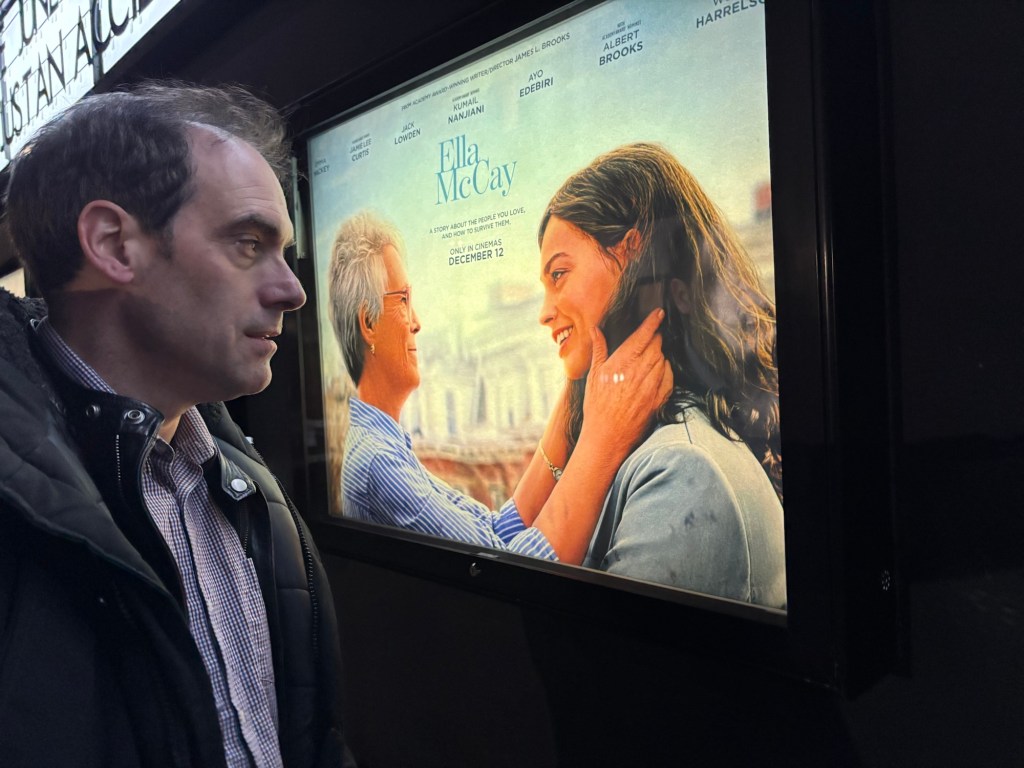
At 85 years old, ‘Ella McKay’ marks the first film in 15 years from James L. Brooks – the filmmaker behind ‘Terms of Endearment’, ‘As Good As It Gets’, and a key creative force in developing ‘The Simpsons’. And watching it, you’re struck immediately by how much this feels like a film from another era. Despite being set loosely in two time lines of 2008 and 2025, it plays like something made in the early 1990s – a kind of studio filmmaking we rarely see anymore.
In many ways, it feels like a gentle swan song. But it also feels like the work of a director no longer quite speaking to a contemporary audience. The film is earnest, contrived, and filled with big emotional beats that never quite dig deep enough. Trauma is signposted early on, but it’s “trauma-lite” – acknowledged rather than explored.
The story centres on Ella McKay (Emma Mackey), a deputy governor of an unnamed American state who suddenly finds herself navigating political crisis alongside personal upheaval. Her father’s reputation has been tarnished by long-running extramarital affairs – carried on even while her mother was dying – and just three days into her new role as lieutenant governor, Ella’s own husband delivers an ultimatum. The resulting crisis of faith could either boost her public standing or destroy her political future.
Like ‘Terms of Endearment’, the film is interested in family dynamics – but here those tensions are filtered through the lens of public office. Jamie Lee Curtis plays Ella’s aunt, a maternal figure who repeatedly advises her never to lie. Of course, the film eventually asks whether that promise can really be kept. The problem is that the dialogue often feels more suited to a sitcom than to people experiencing genuine political or emotional consequences. These characters talk like characters, not like real people.
The film also presents an unusually idealised vision of politics. These are liberal politicians for whom the worst imaginable scandal is a sexual tryst conducted by a married couple in the Governor’s mansion during working hours – technically illegal, yes, but strikingly tame when set against the realities of contemporary American politics. If this is the biggest crisis on the table, it places everything else happening today into stark relief.
There are moments that feel unintentionally comic: press pack literally banging down doors after a revelation; a character supposedly concussed, immediately declared fine, then casually chatting in a car; Ella practising cathartic shouting sessions with her aunt while cheerful drivers and state troopers wait patiently outside. It all feels oddly benign.
The film it most resembles is ‘Dave’ – another political comedy where individuals may falter, but the system itself remains fundamentally sound. There’s a nostalgic belief here that decency wins out, that integrity is ultimately rewarded, and that democracy, while occasionally messy, is resilient. It even carries echoes of ‘Mr. Smith Goes to Washington’ in its moral optimism.
We don’t really see films like this anymore. And while ‘Ella McKay’ is undeniably clunky and drenched in sentimental gloss, it’s also difficult to dislike. Watching it stirred a surprising nostalgia for a time when Hollywood regularly made studio films that believed – perhaps naively – that good people could still rise, learn lessons, and land on their feet.
It may be implausible. It may be old-fashioned. But there’s something oddly comforting about a film that still believes virtue matters – even if it insists on telling us that lesson every step of the way.
 Chris Deacy
Leave a comment