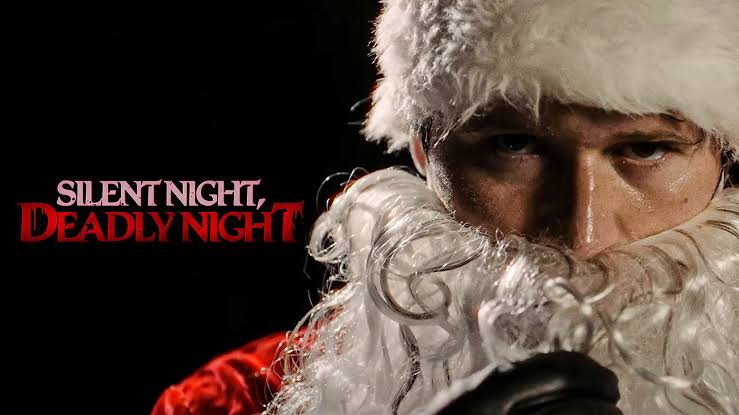
This is a deliberately trashy film that takes the tropes we usually associate with Halloween and drapes them in Christmas lights. At its core, it’s a slasher that uses the Advent calendar itself as a countdown to violence, with each day marked off as another “evil” person is punished. We even see the calendar being ticked down, making the season of goodwill feel ominous rather than comforting.
The backstory isn’t a million miles away from Bruce Wayne and Batman: as a child, Billy (Rohan Campbell) witnesses his parents being brutally murdered by a deranged Santa figure. As an adult, he dons the Santa suit himself and begins a bloody crusade against those he perceives as corrupt or immoral. Billy is a transient loner, but he also falls in love – and the woman he’s drawn to has her own violent, impulsive tendencies. She struggles with rage, and there’s an unsettling sense that this mutual volatility is what attracts them to each other.
The film mixes its moral targets quite aggressively. At one point Billy goes on a killing spree against neo-Nazis, including a scene that borders on the absurd when he meets a seemingly ordinary parent at an ice rink, only to discover she’s hosting a white-power Christmas gathering. It’s clearly aiming for black humour, though these moments sometimes feel contrived and sit awkwardly alongside what could have been a more focused character study.
There’s also a secondary plot involving “The Snatcher,” the town’s bogeyman who is abducting children, and this muddies the waters further. Billy experiences flash-forwards of the people he’s about to kill, guided by the disembodied voice of the Santa who murdered his parents – a presence that may be psychological, supernatural, or something in between. The film toys with ideas of alter egos and spirit transference, with echoes of ‘Harvey’, ‘Venom’, and even ‘Fallen’, the 1998 Denzel Washington thriller about demonic possession and voice-to-voice influence.
The suggestion is that Billy may not simply be schizophrenic, but could be receiving some form of external or ESP-like communication. That’s an intriguing idea, but the film never fully commits to it. In the end, ‘Silent Night, Deadly Night’ is full of smart, provocative concepts – about inherited trauma, moral absolutism, and seasonal hypocrisy – but they never quite cohere. The ingredients are there for something sharper and more unsettling, yet the film settles for being a messy, intermittently clever Christmas slasher rather than the psychological horror it flirts with becoming.

 Chris Deacy
Leave a comment