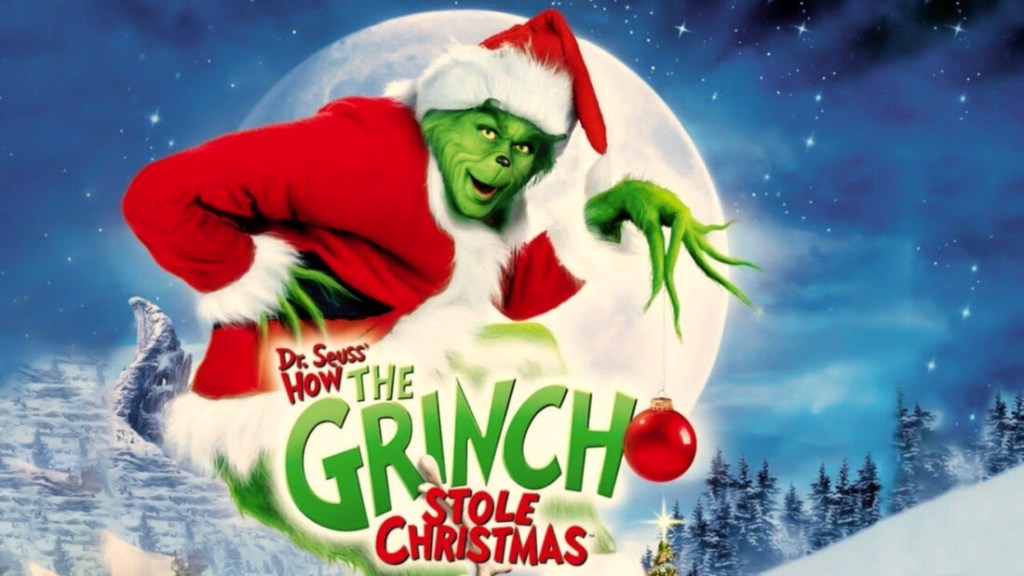
‘How the Grinch Stole Christmas’ feels like a role Jim Carrey was born to play – arriving six years after ‘The Mask’, it gives him free rein to become a live-action cartoon. Based on Dr. Seuss’s 1957 book, the film blends ‘A Christmas Carol’ with something closer to ‘Edward Scissorhands’: a misanthropic outcast perched high above society, wounded by childhood rejection and lashing out at a world he feels has humiliated him.
The Grinch lives alone atop Mount Crumpit, nursing spite and resentment. This version gives him a backstory – his schooldays were traumatic, his difference cruelly mocked – and that damage has calcified into hatred. He’s so embittered that he becomes a literal inversion of Father Christmas, stealing presents from Whoville’s children and sabotaging the festive cheer below.
Ron Howard directs with a flair for redemptive schmaltz. The Grinch lurks amid toxic waste, sneaks into Whoville to play cruel pranks, and even gifts children deliberately upsetting presents. At heart, though, this is a critique of commercialism. Whoville’s residents go into a festive frenzy – shopping, decorating, buying – without ever stopping to ask why.
That question comes from Cindy Lou Who (Taylor Momsen), the film’s moral centre. As a child, she’s dismissed for being naïve and transgressive – for daring to suggest that Christmas might mean something beyond consumption. But of course, she’s right. Her quiet insistence ultimately exposes the emptiness at the heart of Whoville’s festivities, and she even manages to redeem the Grinch himself.
In that sense, the film echoes ‘Groundhog Day’. Like Phil Connors, the Grinch is sarcastic, superior, emotionally detached – convinced he’s above the people around him. And, like Phil, he eventually softens. Jim Carrey throws himself into the role with manic energy – tumbling, contorting, bouncing off sets – but the performance is so relentless it can feel exhausting rather than moving.
The film relies heavily on a familiar Hollywood device: the child who sees what adults can’t, who believes in the magic everyone else claims to cherish but has long since hollowed out. Cindy Lou invests all her faith in this damaged misanthrope and refuses to accept rejection.
It’s colourful, frenetic, and occasionally funny – but also oddly hollow. For all its noise and movement, ‘How the Grinch Stole Christmas’ can feel overstuffed and emotionally thin, repeating well-worn festive tropes in louder, stranger packaging.




 Chris Deacy
Leave a comment