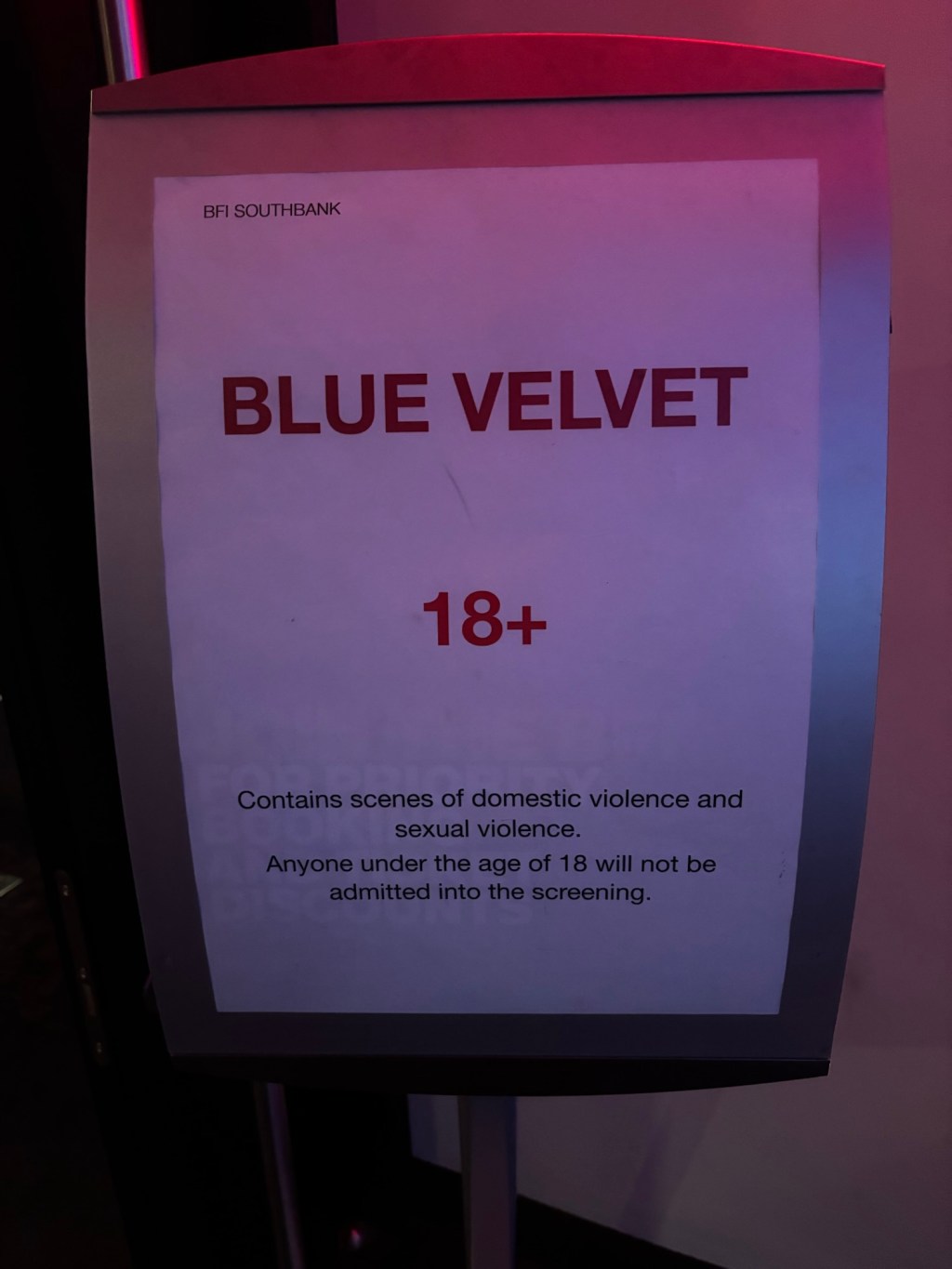
‘Blue Velvet’ is David Lynch’s unsettling, mesmerising dissection of suburban morality and the rot that festers beneath white-picket-fence respectability. There’s something here of the off-kilter take on the detective genre in Robert Altman’s ‘The Long Goodbye’, but filtered through Lynch’s singular, nightmarish imagination.
The opening image is key: hyper-stylised red roses, impossibly white fences, and an artificially blue sky – a postcard version of America – before the camera plunges underground to reveal insects writhing beneath the lawn. It’s a perfect metaphor for what follows. This is a film about what we choose not to see.
Kyle MacLachlan plays Jeffrey Beaumont, a small-town adolescent who stumbles into a mystery after finding a severed ear in a field. That discovery sparks a compulsion to play detective, drawing him into the shadowy netherworld of Lumberton. He confides in the local police chief – who is also the father of Sandy, the girl he fancies – and with Sandy (Laura Dern), begins to imagine what horrors might exist behind closed doors.
There’s a Hardy Boys or Nancy Drew innocence to their investigation at first, but it quickly curdles. Sandy is the catalyst – she’s the one who pushes Jeffrey to follow clues – yet she never fully enters the underworld herself. Instead, she experiences it vicariously, through Jeffrey, who goes far further than either of them anticipates.
At the centre of the film’s darkness is Dennis Hopper’s Frank Booth – one of the most psychopathic figures in cinema history – and Isabella Rossellini’s Dorothy Vallens, a lounge singer trapped in a sadomasochistic relationship defined by coercion, fear, and sexual violence. Their relationship exposes desire stripped of tenderness, intimacy replaced by domination.
One harrowing sequence, in which Jeffrey is taken on a nightmarish car ride by Frank and his gang, explicitly recalls ‘A Clockwork Orange’. Violence here isn’t just physical; it’s psychological, eroticised, and ritualised. Lynch asks why people deviate from social norms – and whether those norms were ever anything more than a façade.
Voyeurism is everywhere. Jeffrey hides in closets, watching Dorothy perform, watching her suffer. Frank even punishes Dorothy for looking at him while he enacts his fantasies. Seeing is power; seeing is knowledge – and seeing is dangerous. It’s no accident that the film’s central object is an ear: a grotesque emblem of perception in a story obsessed with watching, listening, and crossing forbidden thresholds.
Unlike films where corruption is limited to a few “dirty cops”, ‘Blue Velvet’ suggests something far more disturbing: complicity. Authority figures, criminals, and impostors bleed into one another. Respectable surfaces conceal irredeemable evil.
In this sense, ‘Blue Velvet’ feels like a precursor to ‘Eyes Wide Shut’ – another film about respectable people entangled in unspeakable acts. It’s also a warped coming-of-age story, where adolescent curiosity collides with adult depravity, and desire becomes indistinguishable from danger.
That severed ear is never just an ear. It’s a symbol of malaise, of what we overhear but pretend not to understand. In a film obsessed with looking, Lynch places an organ of hearing at its heart – a reminder that the most disturbing truths are often right there, waiting to be noticed.
‘Blue Velvet’ isn’t just disturbing; it’s incandescent – a film that insists the darkness isn’t elsewhere, but right beneath our feet.




 Chris Deacy
Leave a comment