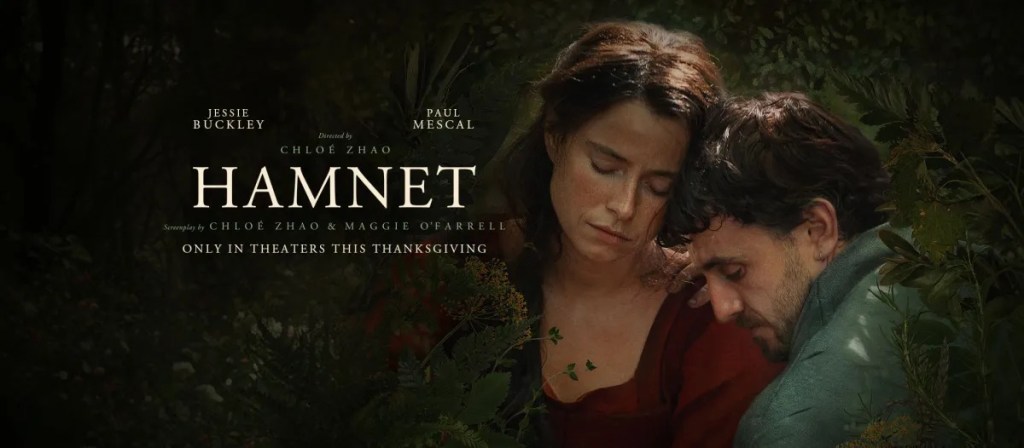
‘Hamnet’ is an extraordinary film because, although on one level it’s about William Shakespeare (Paul Mescal), it’s far more interested in his wife Agnes (Jesse Buckley) – and in the way love and loss can be channelled into an artwork of enormous cultural power.
Agnes is viewed by her community as something like a witch: she can read people’s life-force through touch, and there’s a distinctly pagan, folk-mystical quality to her character. What’s so striking, and ironic, is that when Shakespeare is in her presence he seems almost lost for words. The greatest playwright in history appears, in person, oddly inarticulate. It’s as though he compensates by transferring everything into language on the page, turning emotion into text and grief into structure.
The film’s core is the loss of a child and the tidal pull of grief, guilt, and absence. It becomes impossible not to notice the cruel, haunting closeness between ‘Hamnet’ and ‘Hamlet’: the film treats that near-identical naming not as trivia but as a kind of portal into their inner life – as though the play is not merely inspired by loss, but built from it. In that sense, the story isn’t about genius in isolation; it’s about what genius costs, and what it transforms.
The director’s approach is also crucial. This is a film with the naturalistic, earthy texture associated with Chloé Zhao – it even recalls ‘Nomadland’ in the way it favours lived-in realism over polished period-pageantry. It’s miles away from something like ‘Shakespeare in Love’, which offers a more conventional costume-drama sheen. Here, Elizabethan England feels rustic and unglamorous: mud, wood, work, breath, and hardship. It’s not interested in romanticizing the era so much as making it tactile.
The film also raises a thrilling question: what would it have felt like to be present at the first public performance of a Shakespeare play? We don’t just get the written word; we see it translated into bodies, voices, and space. And that’s where Agnes’s journey becomes so moving. At first, she is appalled: the ‘Prince of Denmark’ story seems to have nothing to do with the child she lost. But then she begins to recognise the transmutation – the way personal grief has been reshaped into public myth – and the realization hits with enormous force. It’s one of those moments where the film’s conceit becomes emotionally undeniable, and I witnessed people leaving the cinema in tears.
What makes ‘Hamnet’ feel so modern – and so difficult to imagine being made decades ago – is precisely that central inversion: the world’s most celebrated dramatist is not shown as a great public orator, but as someone whose eloquence may exist only in the work itself. Almost like a radio presenter who can be spellbinding on air, yet less fluent outside that frame. It’s an audacious idea, and it deepens rather than diminishes him.
There’s trauma under the film’s surface too, not only in bereavement but in the sense of disapproval and constraint around Agnes and William’s union – Shakespeare’s mother’s opposition hangs in the background like a shadow. And structurally, the film emphasises separation: much of it is Agnes alone in Warwickshire while William goes to London. It’s hard not to read that through a contemporary lens: the work-life balance, the sacrifices demanded by ambition, the asymmetry of who stays and who leaves.
In that sense, the film has been described as a kind of creation myth – not just of ‘Hamlet’, but of the conditions that make great art possible. It’s also, unmistakably, about the pain and sacrifice of women within a patriarchal world, and how that pain can be absorbed, rebranded, and immortalized in a culture that tends to remember the male name on the cover. Agnes is not a footnote here. She is the soul of the story.




 Chris Deacy
Leave a comment