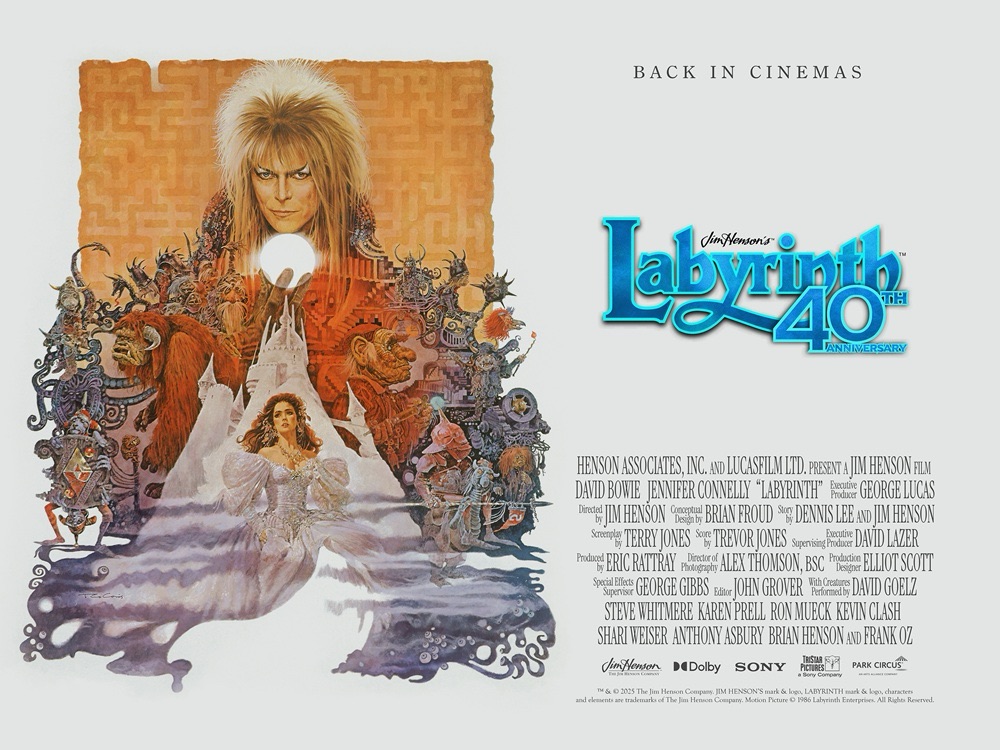
This is a film I first saw on Christmas Eve 1989, and I vividly remember watching it while listening to a Phillip Schofield Christmas Eve special on Radio 1. It stayed with me for years, partly because of its sheer oddness, but also because of the central performance by Jennifer Connelly, who plays Sarah as a kind of hybrid figure – part Dorothy, part Alice in Wonderland. If anything, Alice is the closer parallel, given the riddles, the constant falling through spaces, and the sense of being trapped inside a logic that never quite explains itself.
This is, of course, a film from the world of Jim Henson, and the Muppet aesthetic is everywhere: playful, grotesque, anarchic, and very pre-digital. There’s a Basil Brush–style cheekiness to the whole enterprise, and structurally it’s a familiar odyssey. Like Dorothy following the yellow brick road, Sarah must traverse a maze to reach a castle – except here it belongs to Jareth, the Goblin King, played by David Bowie. He has taken her baby brother after she rashly wishes him away because she doesn’t want to deal with his crying while her parents are out for the evening – a decision she almost immediately regrets.
What follows is a punitive quest through the labyrinth, aided by a motley collection of goblin companions who clearly echo Dorothy’s allies on the road to Oz. Along the way, Jareth plays elaborate mind games with Sarah, and the film gradually suggests that she may, in fact, have more power over him than he has over her. In that sense, the Oz parallels are explicit and deliberate. As family entertainment, it’s imaginative and often delightful, but revisiting it nearly forty years on, it doesn’t quite hold up in the way I hoped it might.
The film leans heavily on the hero’s journey template: the call to adventure, the trials, the riddles, the tests of resolve, and the eventual confrontation. Sarah, like Alice, is constantly falling down holes, navigating traps, and choosing between doors that promise radically different outcomes – including delights like the Bog of Eternal Stench. The screenplay, co-written by Terry Jones, has plenty of wit, and there’s even something of ‘The Princess Bride’ in the swordplay and whimsical tone.
But for all its invention, the film feels curiously shallow. We know from the outset that Sarah will reach the castle, and unlike Dorothy, she’s a more opaque figure. We’re given a sketch of her home life – a stepmother, a half-brother, and a resentment about being forced into responsibility – but once the journey begins, character motivation gives way to a series of set-pieces. It becomes less about transformation and more about endurance. Each obstacle is overcome, only for another to appear, and because the film continually wrongfoots us, suspense never really builds. We know she’ll escape, regroup, and move on. Five minutes later, it happens again.
Roger Ebert noted in his original 1986 review that films are often more interesting when humans enter the Muppet world than when Muppets enter the human one, and in light of something like ‘The Muppet Christmas Carol’, that feels persuasive. In that film, Michael Caine anchors the fantasy with emotional gravity. Here, when the goblins spill into Sarah’s bedroom at the end, singing and dancing, it retroactively drains the preceding adventure of mystery. What we’ve watched suddenly feels thin, almost insubstantial.
That’s the central issue: nobody is really stretched. Sarah’s journey doesn’t seem to demand growth in the way Dorothy’s does in ‘The Wizard of Oz’. The Tin Man, Scarecrow, and Lion confront fears that change them. In ‘Labyrinth’, the creatures Sarah encounters exist largely to serve her progress, not to be transformed themselves. Jareth, too, lacks an independent inner life. He exists only in relation to Sarah – alternately dominant and strangely servile – a projection rather than a fully realized antagonist.
In the end, Sarah accepts fantasy into her reality, but it’s unclear what that actually means for her maturation. Does she really grow? What has she learned beyond asserting control over a world that was always hers? The labyrinth has no real centre of gravity, no social world beyond its function as a testing ground. Compared to Oz, it feels enclosed and self-contained. ‘Labyrinth’ follows the mythic hero’s journey almost beat for beat, but it misses the crucial final step: genuine transformation. That absence leaves it enchanting, imaginative, and visually extraordinary – but emotionally lightweight, especially when set against the richer moral and psychological journey of Dorothy in ‘The Wizard of Oz’.



 Chris Deacy
Leave a comment