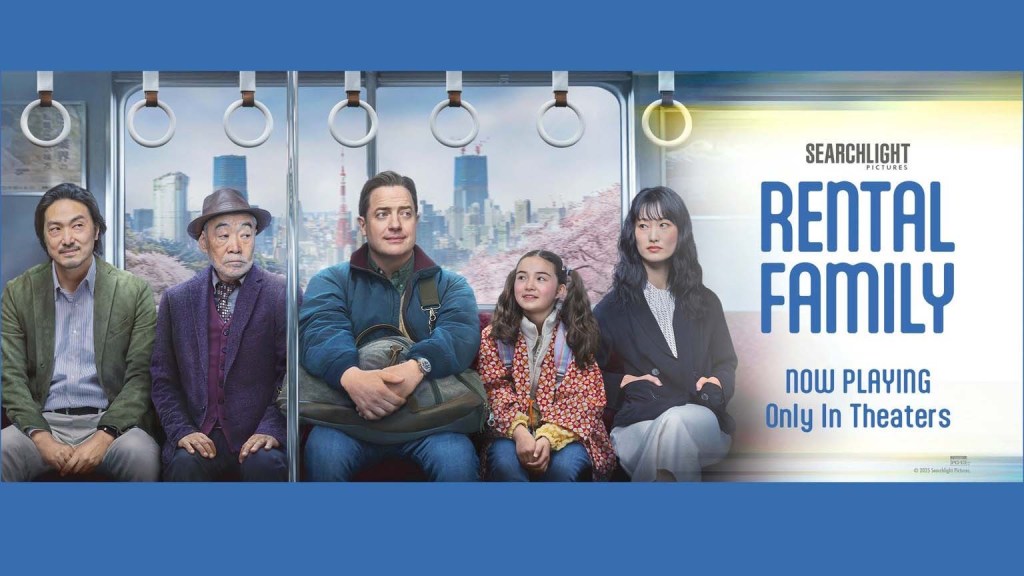
‘Rental Family’ is a quietly devastating film built on a deceptively simple idea: what happens when “acting” stops being a performance and starts becoming a way of life. There are shades of ‘The Truman Show’ in the way people curate themselves in public, but this is more intimate – less about spectacle than about the everyday masks we wear, and the emotional fallout when someone decides to make those masks real.
Brendan Fraser plays an American drifter in Tokyo, marooned there for years and still feeling slightly out of place – a little ‘Lost in Translation’ in his displacement and loneliness. He came seven years earlier for a toothpaste commercial job that never became the career breakthrough he hoped for, and now he’s scraping by working for an agency that rents people out to play roles in other people’s lives. Sometimes it’s absurd: a hired “mistress” to stage a confrontation, or a fake fiancé, or a stand-in parent. But often it’s heartbreaking: someone needs a father figure for a child long enough to secure a place at a prestigious school, or a companion to complete a picture of family that life hasn’t provided.
The film’s brilliance is that it doesn’t treat these assignments as “skits” – Fraser isn’t stepping onto a stage and then stepping out again. He’s in apartments, cafés, streets, weddings: real spaces where performance has consequences. At first, it’s a job – a way to pay the bills – and he does it because, as a very visible outsider, he’s “useful” to clients who need a token Western figure for a particular scenario. But then something shifts. The roles start to stick. He begins forming genuine connections with people he’s only meant to be pretending to care about, and that’s where the film becomes quietly radical: he crosses the line, again and again, until it’s no longer clear where the script ends and where he begins.
It also becomes a sly meditation on what acting actually is. It’s easy to think acting is just pretending – something you do for two hours and then leave behind. But this film insists acting is closer to selling emotion: embodying a person so convincingly that someone else can lean on it, believe in it, and build part of their life around it. And when that happens, the ethical stakes change. An audience knows a film is fiction; a child texting a “father” doesn’t. A lonely client who starts to rely on a fabricated bond doesn’t.
The story takes increasingly uncomfortable turns as Fraser’s character starts continuing relationships beyond what’s required – the biggest example being his bond with a young girl, maintained by messages and calls that the mother either doesn’t know about or can’t control. There’s also an extraordinary thread where he takes an elderly actor on a kind of pilgrimage that borders on abduction – not out of malice, but because compassion and impulse override procedure. Even a wedding scene, where he’s meant to perform as a groom, becomes a crisis point: he almost bolts, unable to stomach the deceit, and from that moment on you feel him moving in the opposite direction – away from being a hired surface presence and towards something messier, more human, and more morally complicated.
It could be argued that the film flirts with “white saviour” optics – the conspicuous foreigner whose intervention changes other people’s lives – but it’s careful to keep him fragile rather than heroic. He’s isolated, adrift, and visibly out of sync with the world around him; he doesn’t “fix” people so much as stumble into their needs and then struggle with the responsibility of being what they asked for.
What makes ‘Rental Family’ so affecting is that, like ‘The Truman Show’, it starts with a fake scenario – something that feels constructed – but uses it as a path to an unnervingly real conclusion: the discovery that connection can be both manufactured and sincere, that kindness can come from a lie, and that the roles we play to survive can end up revealing who we actually are.

 Chris Deacy
Leave a comment