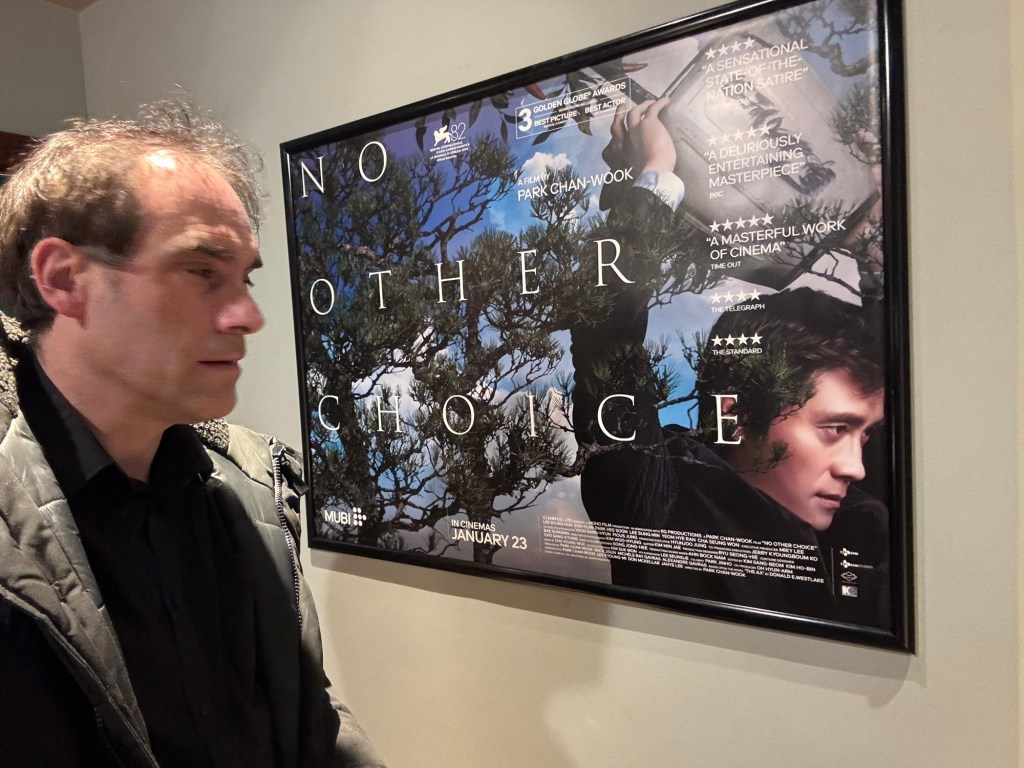
This is a really dark film, very much in the mould of Korean satires like ‘Parasite’, about a family pushed to desperate measures – or rather, a father who is, when he loses his job. It also has something of ‘Kind Hearts and Coronets’ about it: the idea that when someone who has done the same work for years faces sudden redundancy, panic sets in. What’s he going to do? He knows that if he starts applying for other jobs in his sector he’ll be up against brutal competition – someone younger, more qualified, more “vibrant”. So he hatches a plan not to improve his own prospects, but to eliminate his rivals.
He’s worked for 25 years at a paper factory, and the relatable sting here is how quickly a stable existence can unravel. He has a mortgage, bills, a family, and not nearly enough time to reinvent himself. The film’s ingenious twist is the method: he sets up a fake paper company and invites applications from people like him who’ve also been laid off. That way he can see exactly who the competition is, what their skillsets are – and, by spying on them, learn the details of their private lives too: who’s having an affair, who’s struggling financially, who’s lying to their family. The grim joke is that they’re not so different from him. He isn’t uniquely unlucky; he’s simply one of many.
There’s also a slyly funny irony in the fact that this is a man steeped in paper – and even in his fake job scheme he insists everything must be done on paper. It’s an analogue world of letters, phone calls, printed CVs, and that stubborn old-fashionedness becomes part of the film’s wider point. By the end it has something pointed to say about the threat and evolution of AI: about work disappearing, whole sectors shrinking, and people being left behind.
Another twist is that killing people is not as straightforward as he imagines. He isn’t a hitman – he’s a scared middle-aged man improvising – and the film mines uneasy comedy from how bad he is at it. That’s why, remarkably, it often plays as slapstick even as it gets bleaker: botched plans, escalating chaos, and a protagonist trying to keep control as everything spins away from him.
Underneath the dark humour is a sharp observation about modern precarity: how people can look comfortably middle class – nice house, tidy garden, respectable routine – and yet be one missed bill away from losing everything. His goal isn’t to build a new life; it’s to get the old one back. But even without spoiling the ending, the film makes clear he can’t escape the fact that the world has changed irrevocably.
And perhaps the most chillingly funny detail is the children’s perspective: the worst thing they can imagine is having to cancel their Netflix subscription. Ultimately the film suggests that the system is ruthless – and that, to survive inside it, he starts to emulate its ruthlessness himself.
 Chris Deacy
Leave a comment