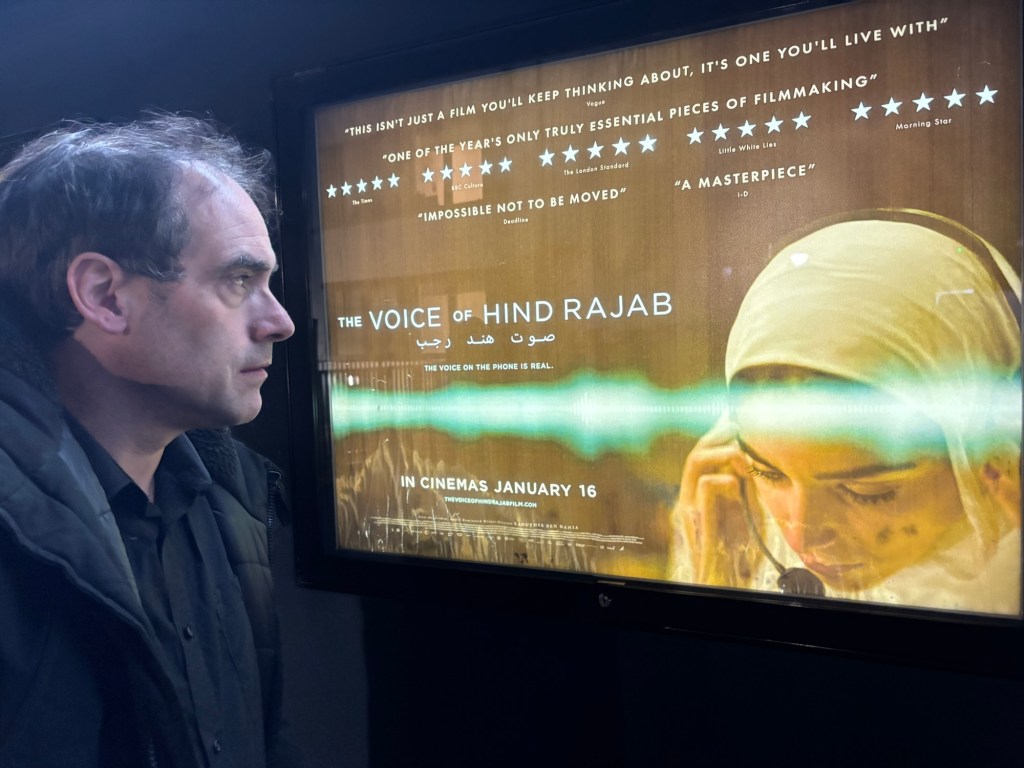
‘The Voice of Hind Rajab’ is a devastating film – essentially a thriller built from documentary reality. It’s based on a real story from January 2024: a five-year-old Palestinian girl in Gaza, trapped inside a car that has been riddled with bullets – we’re told 55 shots hit the vehicle. Everyone else inside, her family members, is dead. Hind manages to phone emergency services, and what follows is almost unbearable in its simplicity: a child on the line, asking to be saved.
She gets through to volunteers at the Red Crescent, but the rescue is anything but straightforward. This is a war zone, and extraction isn’t simply a matter of “going in.” Permissions must be secured, routes negotiated, green lights obtained. Bureaucracy becomes its own antagonist, and the film’s tension comes from that grinding reality: minutes turning into hours, with lives hanging on decisions made behind desks and phones.
Much of the drama unfolds inside the call centre. Some of the staff argue they should intervene on moral grounds – just act, rules be damned. Others insist they have to follow protocol, because the people doing the saving can easily lose their lives if they rush in without clearance. The film doesn’t caricature either side; it shows how impossible these choices are when the stakes are that high and the margin for error is effectively zero.
Crucially, we hear Hind’s actual phone call. The film has the feel of documentary because, in a sense, it is one – the events are real, and the narrative plays out almost in real time. We never see the girl in the car. Instead, the camera stays in the call centre in the West Bank and the horror reaches us through sound, through voices, through the crackle and fragility of a phone line. It’s a stroke of genius, and a brutal one: rather than casting a child actress to “perform” Hind, the film gives us Hind herself. Her words – her last words – become the substance of the film.
That formal choice makes the experience even more harrowing. We don’t need graphic images; the atrocity arrives via what we can hear, and what we can imagine. The gunshots, too, feel horrifyingly authentic. And because we remain with the call centre staff – people who deal with death not just daily but hourly – we’re confronted with another layer of tragedy: the way human suffering becomes routine, the way you take one call, then the next, because the line doesn’t stop ringing.
The film also presses on moral questions that are almost impossible to sit with, not least: What does it mean to coordinate with the very army responsible for the violence, because you still need access, permissions, safe passage? What does “procedure” mean when procedure is built inside a catastrophe?
This is a race-against-time thriller, except it isn’t fiction – and that’s what makes it so powerful. I’m not giving too much away by saying the ending is bleak and devastating. We’re conditioned to expect rescue, closure, some form of release. Here, the thriller mechanics are used to make us feel the crushing weight of what really happened. And underneath it all is a direct, implicating question – a plea, really: you’ve heard this voice; now what are you going to do about it?
 Chris Deacy
Leave a comment