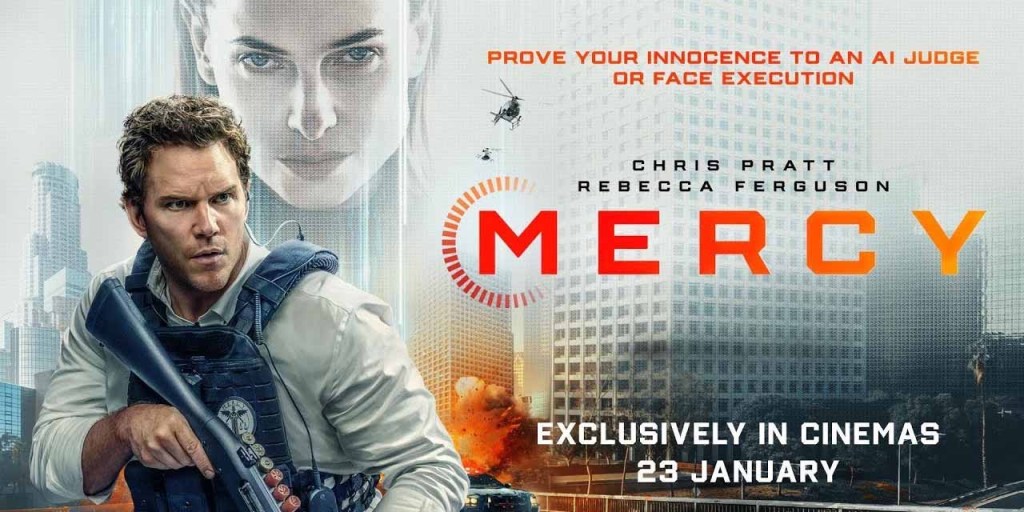
There are echoes of ‘The Fugitive’, ‘Minority Report’ and ‘RoboCop’ in this gripping thriller about a policeman who wakes up to find himself on trial inside a system he helped create – a ‘swift justice’ programme designed to stop chaos and near-civil war on America’s streets. The rules are brutal: suspects are processed at speed, and if an algorithmic verdict tips past a threshold – 92 out of 100 – a lethal injection is administered and order, supposedly, restored.
It’s a terrific hook, because the irony is immediate and cruel. Chris Raven (Chris Pratt), one of the architects of this regime, is now trapped inside it, protesting his innocence as the clock runs down. The film plays out like it’s in real time, complete with a literal countdown, and the tension comes from watching a man try to outpace a machine that has already decided what he is.
The twist is that this isn’t a conventional courtroom drama. Raven isn’t represented by duelling lawyers; he’s effectively forced to become his own investigator from the chair. He can access body-cam footage, surveillance feeds, phone records, documents – the whole data-saturated apparatus of the future state – and he can speak, in the moment, to family members and key figures as he pieces together what looks increasingly like a set-up. Presumption of innocence is flipped: here you’re guilty unless you can prove otherwise.
Overseeing it all is an AI ‘judge’ – human-looking, human-sounding, played by Rebecca Ferguson – supposedly emotionless, yet the film smartly nudges us into questioning whether any intelligence, artificial or otherwise, can ever be truly free of instinct, bias, or gut reaction. And the film’s buried question is its most resonant one: if we already know algorithms fail in the real world, why would we ever hand them life-and-death authority?
There are intriguing modern flourishes too – the screen-within-screen texture you see in films like ‘Searching’ or ‘Missing’, and personal revelations that complicate our loyalties. Raven discovers his marriage wasn’t what he believed; his wife’s death and hints of an affair tilt the story into messier territory than a simple wrong-man scenario. But while the set-up is genuinely clever, the conspiracy engine underneath it can feel familiar – not an especially fresh variation on genre mechanics.
What’s most interesting is what the film doesn’t quite commit to. It’s not really anti-AI, and it doesn’t fully land as an argument against capital punishment either. Instead it sits in a more uneasy, slippery space: a techno-thriller that thrills on the efficiency of the system even as it shows how terrifying that efficiency becomes the moment it targets the wrong person.


 Chris Deacy
Leave a comment