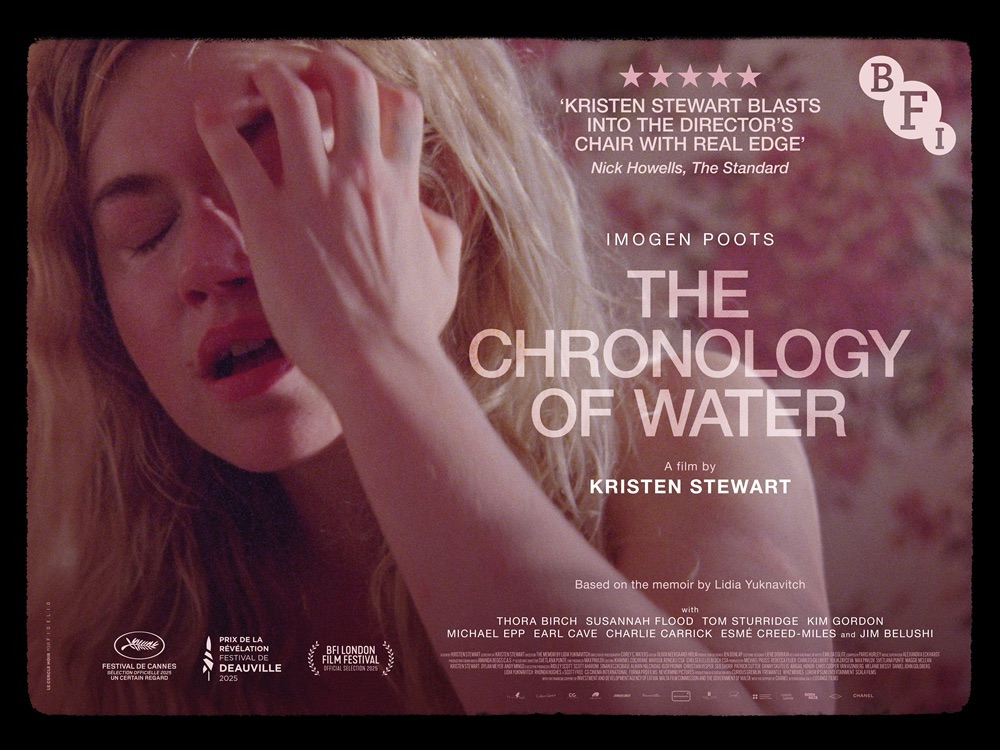
‘The Chronology of Water’ sits very naturally within Kristen Stewart’s fascinating career – a performer who moves fluidly between major studio films and uncompromising independent work, and who was Oscar-nominated for playing Princess Diana. This is one of her most inward, elliptical performances: an intensely introspective trauma narrative about a young woman, Lidia (Imogen Poots), abused by her father, who turns to two outlets to survive – competitive swimming and writing.
The film is about addiction in many forms: drugs, sex, destructive relationships, and even memory itself. Time fractures constantly. We move between emotional states rather than clear chronology, which is ironic given the title. Water becomes the dominant metaphor – immersion, pressure, breathlessness – and the film often feels like being held under the surface rather than guided from scene to scene.
There’s a creative-writing strand involving countercultural novelist Ken Kesey, and this raises one of the film’s central questions: how trauma gets converted into art. Lidia’s writing is raw, sexually explicit, and unsettling – it alienates classmates precisely because it refuses to sanitize pain. These are not memories presented as ‘this is what happened’, but as sensations recalled, distorted, replayed and reworked.
The film includes difficult material – addiction, abortions, a stillbirth, blood and gynaecological imagery – but none of it is sensationalized. Instead, it’s impressionistic and repetitive, mimicking how trauma resurfaces rather than resolves. There’s also a boyfriend who is genuinely kind, but because she is conditioned by abuse, Lidia cannot tolerate gentleness and lashes out at him – a painfully recognizable pattern.
Based on the memoir by Lidia Yuknavitch, this is not a conventional biopic or linear memoir. It operates at the level of consciousness. There’s no exposition, no hand-holding – rather, events are thrown forward, looped back and refracted. We are asked to assemble meaning ourselves, much as the protagonist is doing.
Ultimately, ‘The Chronology of Water’ is less about what happened than about how it feels to remember – and how art can emerge not from order, but from fragmentation.




 Chris Deacy
Leave a comment