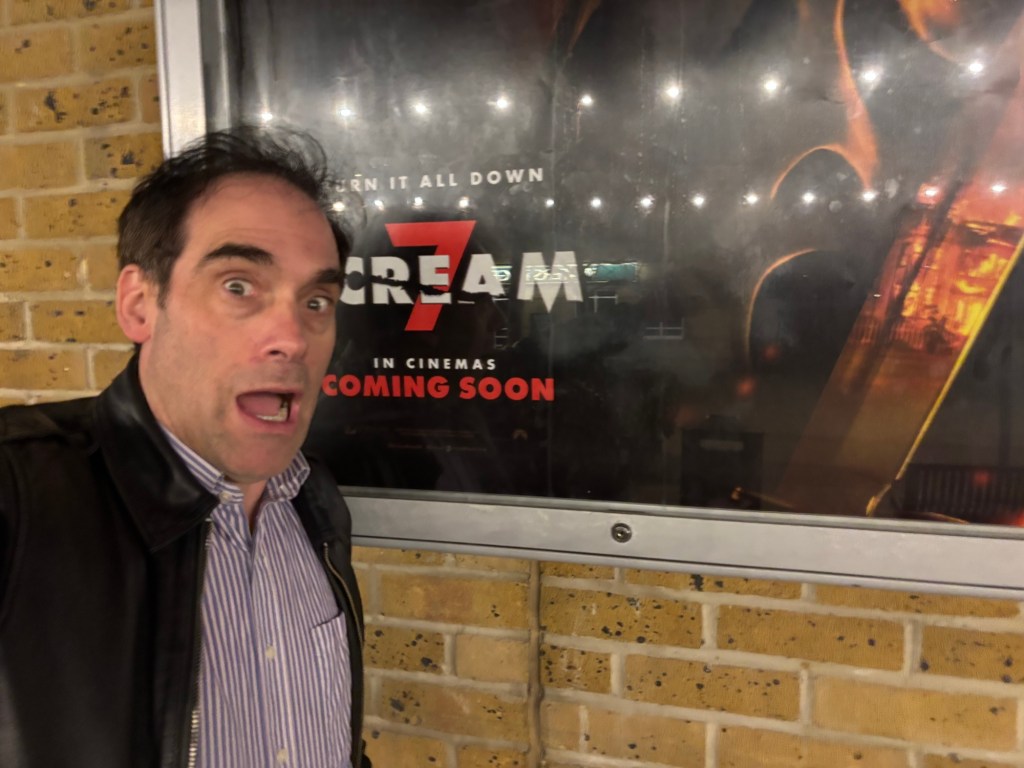
This latest edition to the ‘Scream’ franchise certainly held my attention throughout, but it ultimately feels like a film simply going through familiar motions, locked into a pre-set formula. This time we open with a couple obsessed with the ‘Stab’films – the movie-within-the-movie franchise of the ‘Scream’ universe – visiting a replica house where they are subjected to the familiar roll call of shocks and torments: the phone rings, the victim is asked three questions, and a wrong answer means death by stabbing. It’s knowingly self-referential, but also oddly mechanical.
When the eventual reveal comes – and, predictably, more than one person is responsible – the film drifts into ‘Scooby-Doo’ territory. Once the killers remove their masks, they suddenly behave far less intelligently, allowing Neve Campbell’s Sidney Prescott to outmanoeuvre them with surprising ease, despite having seemed unstoppable moments earlier. One thing that does work well, however, is Campbell herself, whose character remains far more three-dimensional than one might expect from a seventh instalment in a long-running slasher franchise.
In what feels like a nod to ‘Psycho’ and its sequels, characters previously believed dead reappear – perhaps explained through technological manipulation or even hints of AI – adding another layer of elaborate, slightly absurd plotting. The story sends Sidney to a house where her daughter is being held hostage, leading to lengthy exposition scenes conveniently timed so that someone can intervene at the last possible moment to save the day. Taken on its own terms, it’s perfectly watchable, but as the seventh entry in the series one begins to wonder why this story needed to be told at all.
The biggest weakness lies in the arbitrariness of the killer reveal. The culprits are minor background figures who suddenly step forward with lengthy explanations, yet without the psychological grounding or emotional weight the series once handled so effectively. It feels less like a shocking revelation and more like narrative obligation. Still, the film does gesture toward deeper themes – trauma, legacy and nostalgia – particularly in the evolving relationship between Courteney Cox’s journalist Gale Weathers and Campbell’s long-suffering survivor. Their uneasy alliance, once defined by exploitation versus survival, has matured into a grudging mutual respect.
Yet the decision to include multiple killers increasingly feels like a narrative shortcut: dispatch one Ghostface and another immediately appears, rather like ‘Jurassic Park’ replacing one dinosaur with the next. That cyclical repetition becomes the film’s defining trait – entertaining in the moment, but also faintly desperate, as though the franchise itself cannot quite escape the pattern it created.
 Chris Deacy
Leave a comment