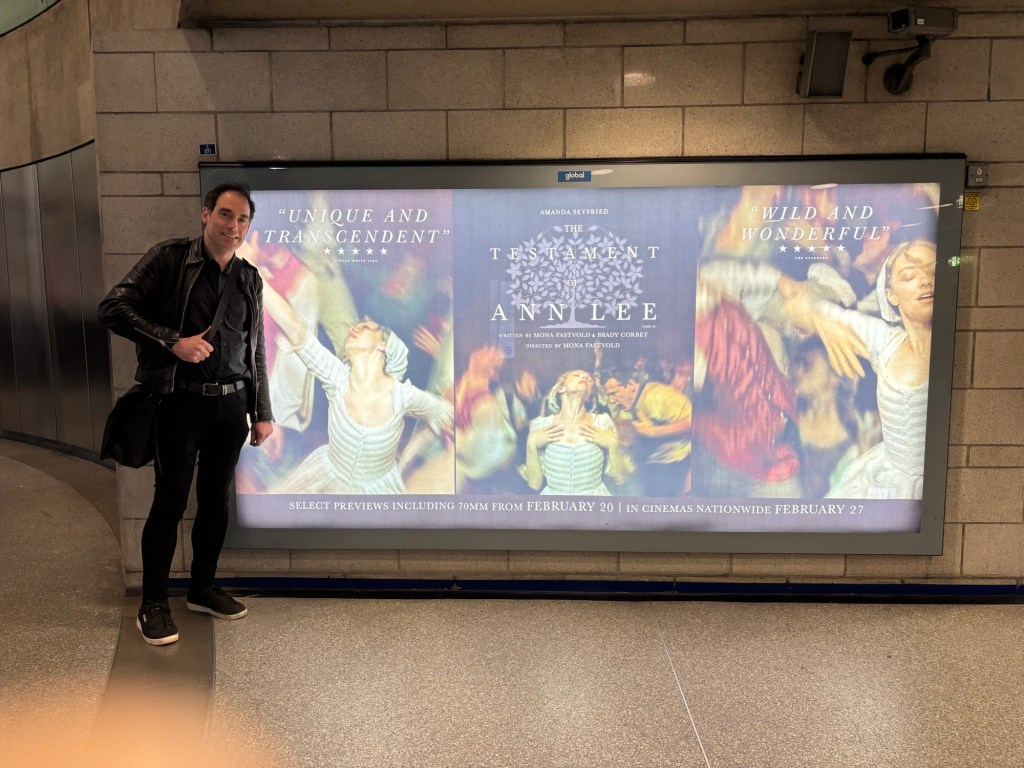
This is a film about the 18th-century religious leader Ann Lee, presented as a musical that feels at once primal and strangely exhausting. Lee, played by Amanda Seyfried in a convincing Manchester accent, is depicted as the founding figure of the Shaker movement, and the film is fascinated by the sect’s belief that the sin associated with sex could be purged from the body through ecstatic movement and dance. The rituals become both spiritual expression and physical release.
Ann’s personal tragedy lies at the heart of her transformation. She bears several children, all of whom die within a year, and for her the act of sex becomes inseparable from grief and guilt. Convinced that bodily desire is the source of suffering, she embraces celibacy as a path toward salvation. Her husband, whose relationship with her has been deeply physical, resents this decision and wishes to remarry, but Ann refuses to grant him that freedom. The film draws on quotations from the period – not from Lee herself, who was illiterate – as it traces her journey to the United States and the gradual expansion of her congregation.
There is a compelling feminist dimension to the story. Ann comes to see herself as a kind of second coming of Christ, a radical claim that sits uneasily within the rigidly patriarchal culture of the time. The film thrives on paradox: a celibate sect expressed through exuberant, almost orgiastic dance sequences; a movement preaching restraint conveyed through musical excess; and a woman advocating spiritual purity while radiating immense personal charisma. Accused repeatedly of witchcraft, she is imprisoned several times, and her endurance gives the film much of its dramatic force.
Yet the musical elements themselves are less memorable than one might hope, and a sense of repetition gradually sets in. The film seems to remain in the same emotional register, its intensity paradoxically becoming inert despite the fervour of its subject. By the end, I felt I understood little more about Ann Lee than I had at the beginning. This is a film experienced more on a sensory and emotional level than an intellectual one.
Stylistically, it recalls a Robert Eggers film in its austere design and minimalist atmosphere, punctuated by expressionistic musical sequences that suggest the film is trying to inhabit multiple modes at once. It never quite feels like a conventional historical drama; instead it unfolds with a dreamlike, elliptical quality during moments of religious ecstasy. That ambiguity is both its strength and its limitation – a film one can admire for its ambition and atmosphere, even if it remains difficult fully to love.



 Chris Deacy
Leave a comment