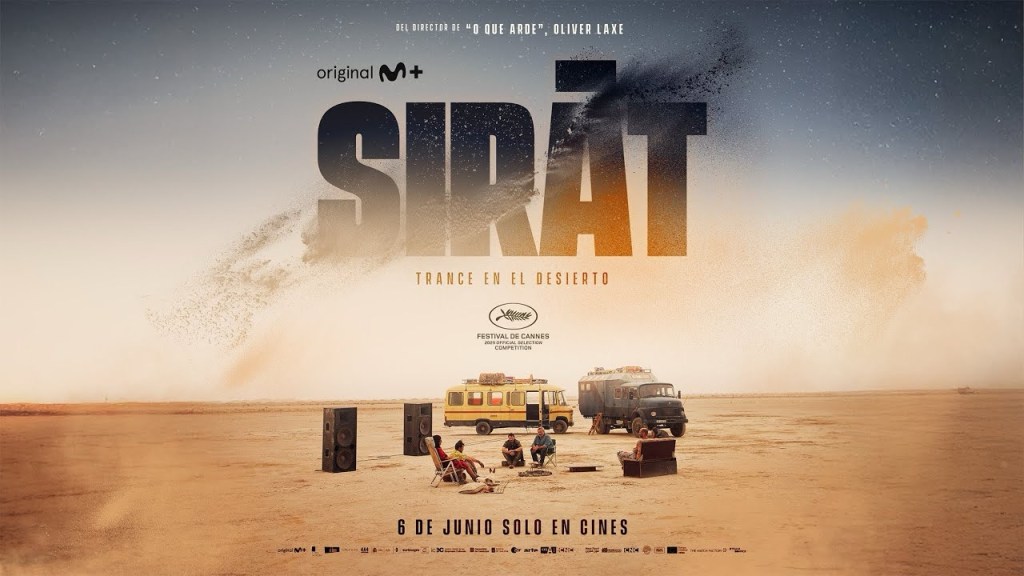
‘Sirât’ brings the ancient and the modern together in a strange and unsettling way. What at first looks like a kind of pilgrimage across the desert turns out to be something else entirely: travellers moving from rave to rave, carrying enormous speakers across the Moroccan landscape. It becomes a modern, almost secular version of Mecca. At the centre of the story is a father searching for his missing daughter, following these nomadic groups in the hope that she might appear among them. His journey becomes an odyssey across a hostile wasteland filled with unexpected dangers, including landmines.
There is something mind-bending about the whole experience. ‘Sirât’ is a visceral film that we feel physically as much as intellectually, although there are clear philosophical and theological questions beneath the surface. It raises issues about fate, mortality and the end of the world. Who is saved and who is condemned? Is our destiny determined by the choices we make in life, or is everything simply random, governed by chance and bad luck?
What stands out about the community we encounter is that these people live on the margins of society. Some have missing limbs, many are heavily tattooed, and the authorities constantly move them along. They seem almost nomadic, living for the intense communal experience of the rave – perhaps fleeing trauma, perhaps the aftermath of war – as though these gatherings offer a kind of spiritual awakening or salvation. Yet the path they follow is an extraordinarily precarious one.
The title refers to the bridge in Islamic tradition that links heaven and hell – a crossing that determines one’s final destination. The quotation that appears at the beginning describes it as ‘as thin as a strand of hair and as sharp as a sword’. In that sense the characters exist in a kind of purgatory, awaiting a fate that may arrive suddenly and without warning. Cars unexpectedly roll backwards down cliffs; landmines explode without notice; bodies are torn apart while others survive by sheer accident.
There is something of Michelangelo Antonioni in the film’s mood and pacing. What begins as a road movie gradually mutates into something far darker in its final act, and at several points I found the imagery so traumatic that I had to look away from the screen – it really is a gut-punch of a film.
A hadith in Islamic tradition suggests that the faithful will cross the bridge safely while the faithless fall into the fire below. That idea provides one powerful lens through which to understand this film. Any sense of community here feels temporary, provisional and fragile. In this bleak, almost post-apocalyptic landscape, the travellers form fleeting bonds, but we know many of them will not make it very far. And perhaps, in this strange liminal world, this precarious existence is all there is.
 Chris Deacy
Leave a comment