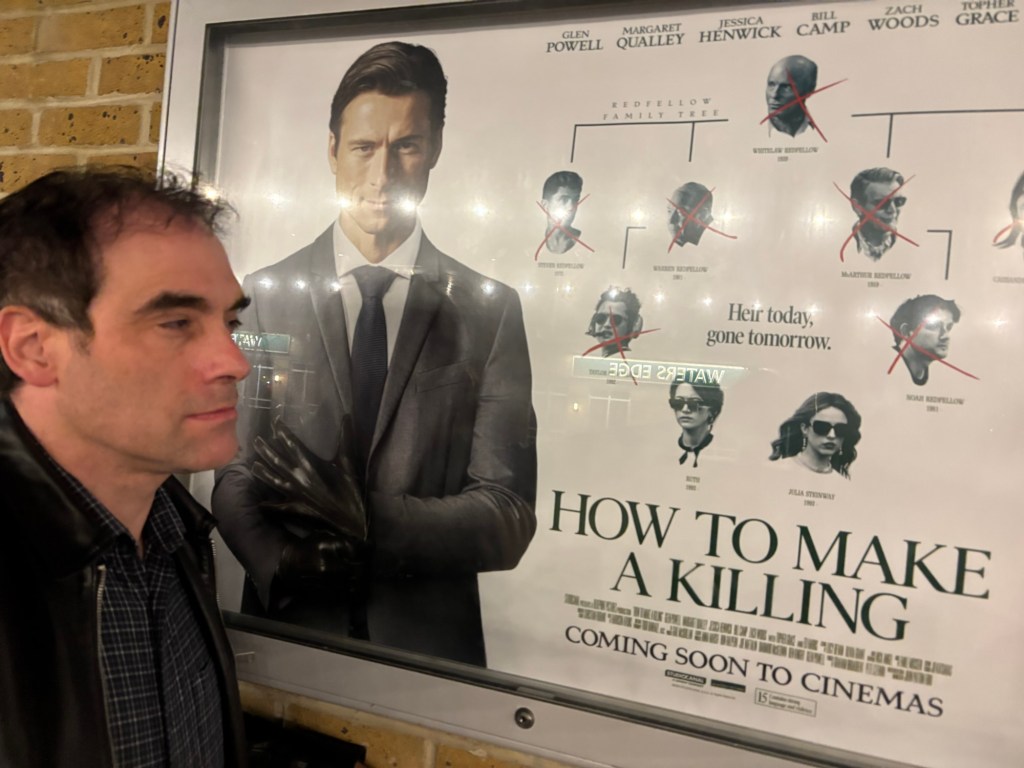
This film is essentially a modern remake of the Ealing classic ‘Kind Hearts and Coronets’, though strangely it never feels as sharp or as daring as that premise might suggest. Glen Powell plays Becket Redfellow, a man whose mother was excluded from a wealthy family after becoming pregnant, yet through a twist of inheritance he still stands to become the heir to an enormous fortune. The catch is that the rest of the extended family must die first. Since they don’t even know he exists, he begins turning up at their homes, methodically eliminating them – poisoning some, drowning others, blowing a few up – in the hope that he will ultimately inherit everything.
Powell has played characters with double lives before, but here he seems to be channelling a kind of Tom Cruise energy without quite possessing the same magnetism. The film reminded me at times of ‘Where the Money Is’, the 2000 film with Paul Newman about an apparently harmless old man in a nursing home who secretly orchestrates one final heist. In that sort of story we usually look for some kind of redemption arc, or at least find ourselves perversely admiring the protagonist’s audacity. Here, however, the supposed shock ending – which hints that the plan may actually succeed – feels oddly flat.
The film relies heavily on last-minute reversals in which characters who have previously been unpleasant suddenly perform acts of self-sacrifice, but because we’ve never been given much reason to care about them, the emotional impact simply isn’t there. Nor do we gain any real insight into what it means to grow up feeling rejected by one’s family. Instead, Redfellow seems to fall into murder almost casually, as though he has always possessed the instincts and techniques required to carry it out successfully.
There are flashes of ambition. Some scenes flirt with the kind of satirical tone you might find in ‘American Psycho’, particularly in moments where the protagonist reflects on his crimes from prison or confesses them to a priest. Margaret Qualley drifts in and out of the narrative as an elusive romantic figure, though her character is barely developed. On the surface there is some fun to be had in the idea of taking revenge on the obscenely rich – echoes of ‘Get Out’ appear here and there – but the film never pushes its satire far enough.
Like ‘Kind Hearts and Coronets’, the story includes two women who might represent different paths for the protagonist, yet their presence feels muddled rather than meaningful. They appear in isolated scenes without the narrative clarity needed to define what they symbolize. Ultimately the film’s shallowness comes from the fact that the hero’s ultimate ambition is simply to become what he claims to despise: another fabulously wealthy man.
That raises an intriguing question the film never fully answers. Has Becket Redfellow become monstrous only after realizing he stands to inherit $28 billion, or was he always this person? Glen Powell has already shown in ‘Hit Man’ that he can play multiple identities within a single film. In some ways that movie feels like a more successful modern descendant of ‘Kind Hearts and Coronets’. If the sharp satire of ‘Hit Man’ had been combined with the premise of this film, it might have been something special. Instead, ‘How to Make a Killing’ feels like a story with only half its ingredients – a clever idea that never quite comes together.



 Chris Deacy
Leave a comment