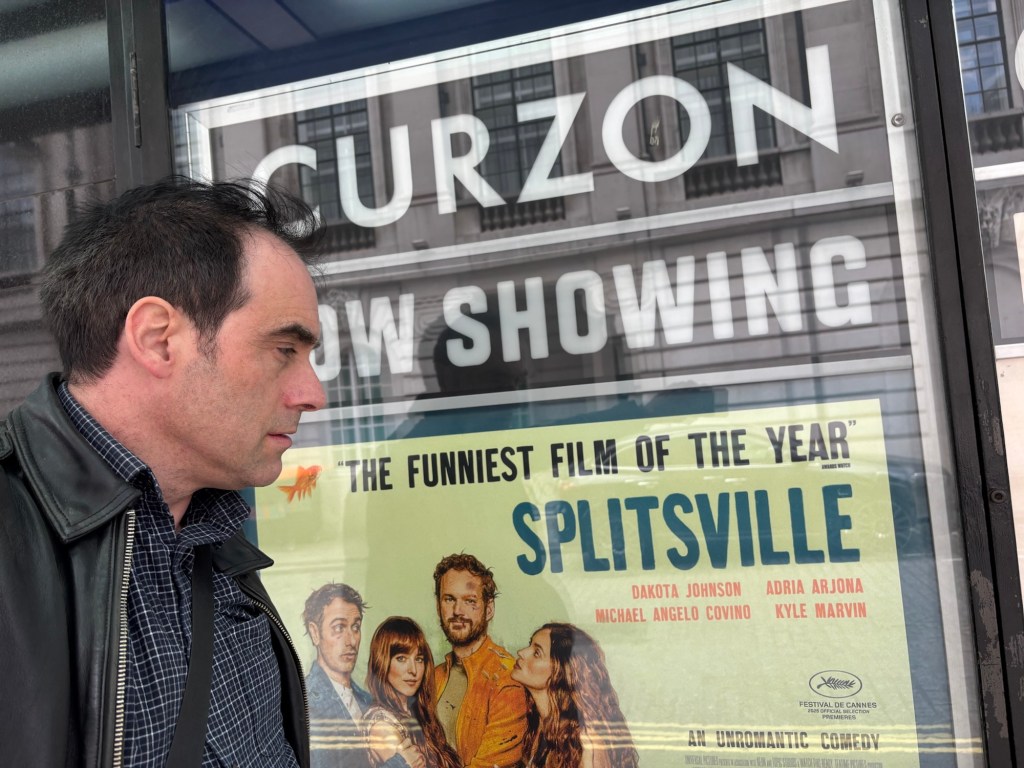
‘Splitsville’ is a black comedy that is technically a little inconsistent, though it carries some deeper undercurrents about relationships and marital dysfunction. At its heart, it explores the idea of open relationships and how the notion of emotional and sexual freedom often collapses in practice – particularly when close friendships are involved. We follow two couples, one whose short marriage is already breaking down, and another who claim to be happily in an open relationship, with the film examining what happens when these two dynamics become entangled.
Dakota Johnson is, as ever, quietly compelling – measured, dryly witty, and with an almost ethereal quality. She becomes the linchpin between these overlapping relationships, though the film deliberately keeps us unsure of where things are heading. From the outset it veers into absurdist territory – an early scene involving a roadside death is intercut with farcical imagery – setting the tone for a film that constantly shifts between comedy and something darker.
Alongside the romantic entanglements, there’s a strong current of male aggression, most notably in a chaotic scene where two men fight over IKEA-style furniture – a moment that neatly captures the fragility of domestic order, such that ‘Splitsville’ becomes a study of what happens when the expected boundaries within relationships are dismantled. In one particularly strange development, the more conventional couple attempt to adopt the open relationship model themselves, leading to a surreal situation in which multiple lovers move into the same house, forming strange little subgroups – watching ‘Doctor Zhivago’, or bonding over football.
There are echoes here of films like ‘Bob & Carol & Ted & Alice’, though updated for a contemporary audience. At its core, the film asks whether it’s possible to find honesty within fundamentally dishonest arrangements, and how people navigate the emotional chaos that follows. Yet for all its ideas, it sometimes feels less than the sum of its parts. There is something serious here, but it’s dressed up as broad, occasionally silly farce, as if designed to guarantee a good night out rather than to fully explore its themes. At times, it even feels as though it has emerged from a set of slightly discordant scripts. What does keep it engaging, however, is the unpredictability – we are never quite sure who will end up with whom, or which emotional path the film will ultimately choose (not that by the end you will necessarily remember the chosen outcome).

 Chris Deacy
Leave a comment