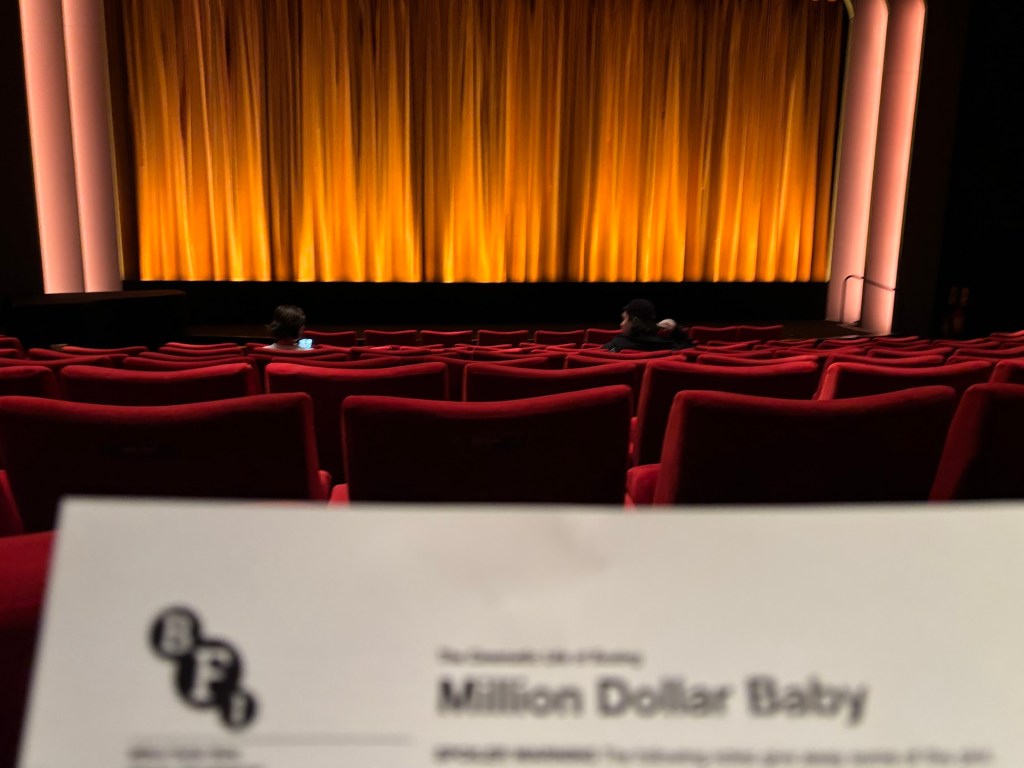
‘Million Dollar Baby’ is is an outstanding film – beautifully textured and one that almost wrong-foots you on a first viewing, because for much of its running time it feels like a layered, character-driven boxing drama. We spend a great deal of time in the ring, following Hilary Swank’s Maggie, a determined female fighter who is desperate to be trained by Clint Eastwood’s grizzled Frankie. The more he insists that he “doesn’t train girls”, the more we see him gradually yield, and what develops between them is a deeply moving, non-romantic love story. Maggie becomes a surrogate daughter, especially as we learn that Frankie’s real daughter is estranged from him – his letters to her returned unanswered.
Frankie is a man burdened with regret. He attends church regularly, though often antagonises the priest, and carries emotional baggage that the film slowly reveals. Then the narrative shifts dramatically. What begins as a sports film moves into far darker territory, confronting the issue of euthanasia and presenting Frankie with an agonising moral dilemma. If you truly care for someone, do you honour their wish to end their life? It’s a question that pushes his already fragile moral compass to breaking point.
In many ways, this is classic Clint Eastwood – echoing the westerns like ‘Unforgiven’, where a man must commit a morally complex act and accept the consequences. The archetype is familiar: the outsider who does what must be done and then walks away, unable to remain within society. That idea is captured poignantly through Morgan Freeman’s narration, as he reflects on Frankie finding “some place where he could find a little peace… somewhere between nowhere and goodbye.” His character is effectively writing to Frankie’s daughter, trying to explain the kind of man her father truly was.
The film also functions as a kind of female ‘Unforgiven’, exploring the gap between myth and reality – between the heroic narrative and the bruised, emotionally tormented individual beneath it. It places mortality at its core, and interestingly, while Frankie reflects on his own limited time, it is Maggie, young and in her prime, whose fate becomes central, both symbolically and literally. The film asks profound questions about how we spend our lives, and about the balance between the quality and quantity of that life.
Maggie’s background adds another layer. Coming from poverty, with a welfare-dependent mother who even rejects the house Maggie buys her, she embodies a fierce independence. Her rise through a male-dominated sport gives the story an additional dimension, a variation on the American Dream in which she fights – literally – to transcend her circumstances. Her determination is precisely what Frankie comes to respect, and their bond becomes one of mutual dependence.
Freeman’s narration recalls ‘The Shawshank Redemption’ – the wise observer reflecting on friendship, loyalty and survival. Yet while both films deal with redemption, ‘Million Dollar Baby’ offers no easy catharsis. There is no sunlit beach, no clear sense of freedom. Instead, the film is steeped in questions of sin and absolution, suggesting, much like Scorsese’s ‘Cape Fear’, that to reach any form of peace or paradise, one may first have to traverse through hell.

 Chris Deacy
Leave a comment