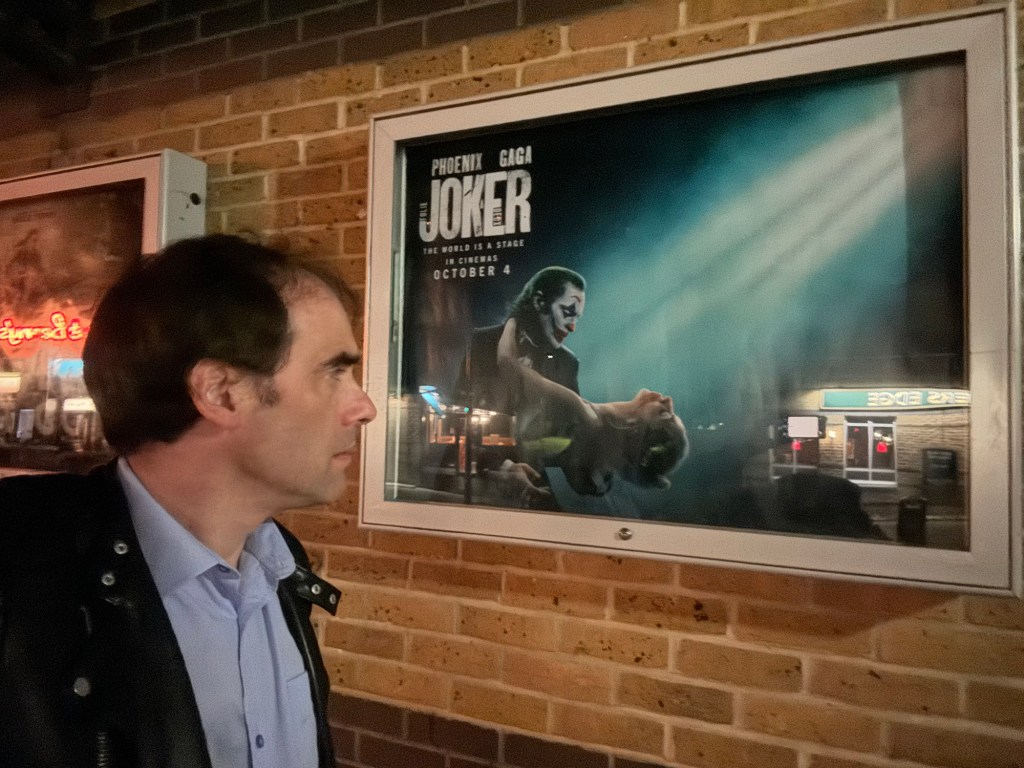
This sequel to ‘Joker’ is a masterclass in how to draw on the tropes that comprise a superhero movie and then relocate them in a totally different genre. And, like the 2019 ‘original’ which bore more than a passing resemblance to Scorsese’s off-kilter masterpiece ‘The King of Comedy’, not least by featuring Robert De Niro in a role reversal to the one he played to devastating effect against Jerry Lewis, here the fantasy sequences are ramped up. ‘Joker: Folie à Deux’ works in its own right as a dark musical, with Lee Quinzel (Lady Gaga) the perfect counterpart/counterpoint to the schizophrenic Arthur Fleck (Joaquin Phoenix) as a fellow inmate who bonds over more than music in a prison musical class, and who instils in Fleck the sort of empowerment and defiance that in any other environment would be seen as a positive thing.
But in the context of schizophrenia and an incarceration while on remand for a murder that took place on live television, instilling in Arthur the sense that he might be free adds additional layers of complexity and imbalance to an already precarious dynamic. Indeed, Lee seems to be putting Arthur on a pedestal as a Messiah-figure who can bring about a new, improved world order. Yet, as with the ambiguous, even twisted, relationship between Jesus and Judas in Scorsese’s ‘The Last Temptation of Christ’, Lee here is soon disappointed by Arthur’s lack of faith in himself, and we are invited to ponder exactly who is betraying whom.
The film’s milieu is an arresting and tantalizing one, giving us a Batman-less Gotham City, and in so doing according this picture an appeal which those who do not really take to comic book superheroes would ordinarily dismiss. This is far removed from previous films in the Batman canon, as with Joel Schumacher’s critically mauled ‘Batman and Robin’ where characters can simply fall into vats of acid and turn into megalomaniacs and psychopaths. The only thing in common is the penchant for puns, though whereas Arnold Schwarzenegger’s Mr. Freeze has a script that consists of a succession of ‘freeze’ puns, what we have in ‘Joker: Folie à Deux’ is an interrogation of the nature of humour and the permeable line between comedy and tragedy.
Arthur/Joker is, after all, a deeply disturbed individual for whom the telling of jokes betrays a layer of introspection and sadness caused by childhood trauma which other films in the canon have not succeeded in dissecting. We see many faces and facets of Arthur/Joker, and the mishmash of ‘reality’ and ‘fantasy’ sequences fit the mode of this film which is also good at asking not just who Joker is but what different perceptions there are of him by others, whether the prison guards who enjoy taunting him, to those in the courtroom at the end who are swayed by his charisma, his defiance of the establishment, his maverick and underdog disposition, and his chutzpah in firing his own attorney so that he can fight his own case, with a series of accents and impersonations which appear to be channelling the movie stars of old, including Gregory Peck who later appeared alongside De Niro’s Max Cady, a film which is being deliberately referenced here by Arthur’s long, curly, greasy hair and a body covered in tattoos.
The multiple layers behind Joker’s personality is also reflected in the film’s use and reframing of genre, much as Scorsese himself did in ‘New York New York’ by thinning the line between a throwback to the classical Hollywood musical of the first half of the twentieth century and other genres which are given equal treatment here, such as a prison movie, a courtroom drama, a film about mental illness in the mode of ‘One Flew Over The Cuckoo’s Nest’ (also replete with a charismatic anti-hero for whom we are being invited to root) and even a Looney Tunes style cartoon, as the first sequence of the movie reveals. This is an audacious, really tough to categorize non-superhero Joker movie and which complements the original so well, even down to the way it invites the audience to ask whether any sympathies we might have accorded Arthur in the first film still deserve our acclamation now that we see the consequences of his behaviour and the sheer absence of resolution or catharsis available.


 Chris Deacy
Leave a reply to Maureen Cancel reply