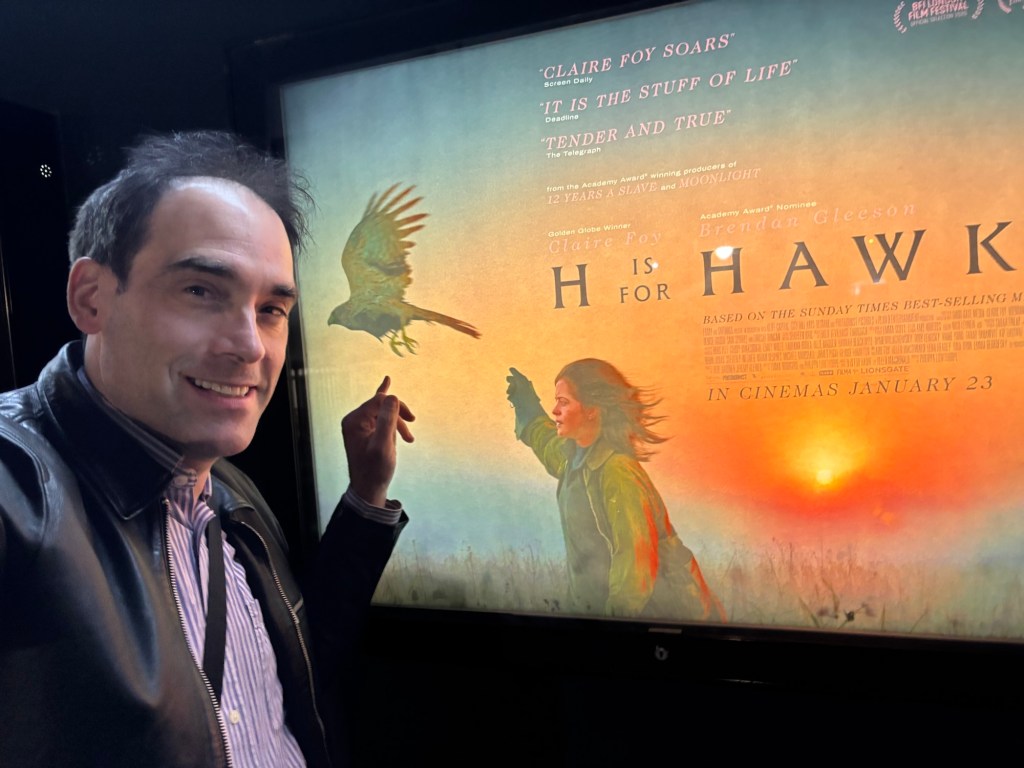
This adaptation of Helen Macdonald’s bestselling memoir, drawn from her life after her father’s death in 2007, is hard to pin down by genre, and that’s part of its power. It’s a quietly devastating film about grief, depression, and the strange, solitary rituals people invent when the usual consolations don’t work.
Claire Foy plays Helen, a Cambridge research fellow and tutor who, instead of ‘processing’ her loss in any tidy way, withdraws. She neglects her students, lets her academic life slip, and even leaves her father’s eulogy until the last possible moment. Her response is not social or therapeutic, but ferociously private: she buys a goshawk and throws herself into the obsessive labour of training it.
The choice is loaded with meaning. A bird of prey – famously unreadable, seemingly without emotion – becomes her companion at precisely the moment she can’t bear the emotional demands of other people. She moves through Cambridge’s ancient, orderly spaces with this wild creature on her arm, but it’s in nature that she finds any kind of solace. The film beautifully threads in the way grief makes you cling to the tiniest relics: she drives her father’s old car, listens to the same music he played – such as ‘Apache’ by The Shadows – and tries, in her own way, to keep him present.
In that sense, the hawk isn’t really the subject so much as the conduit. You could argue the title almost points the wrong way: it’s less H is for Hawk than ‘H is for Helen.’ The hawk, Mabel, is not a cuddly metaphor or a feel-good symbol; if anything, the relationship has the chill of something almost inhuman – a bond with a creature that, in human terms, might feel like living with a psychopath. But grief isn’t polite, and it doesn’t make sane choices. The film is brave enough to sit with that without smoothing it out.
What’s most striking is that this film refuses the usual narrative comfort. In a more conventional story, this would become a redemption arc – a quirky bond that heals her neatly, like a rom-com’s mismatched pairing gradually discovering they’re perfect for each other. Here, the connection is real, but it’s not designed to last. There comes a point when Helen and Mabel must part, and the film doesn’t treat that as failure. It treats it as truth.
By resisting sentimentality, the film keeps its essential eccentricity – aloof, tender, and quietly shattering – and it leaves you with a rare kind of afterglow: not uplift, exactly, but recognition.






Leave a Reply