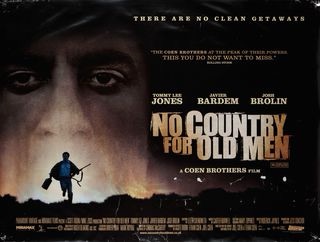
This is a contemporary western with a very dark heart, centred on a drug deal gone disastrously wrong and a briefcase full of cash that Josh Brolin’s hunter character believes he can quietly walk away with after discovering a landscape littered with bodies. He assumes no one will notice – but he is relentlessly pursued by a psychopath played by Javier Bardem, creating a knuckle-tight thriller driven by one of the most terrifying villains modern cinema has produced. Bardem’s Anton Chigurh hunts with an eerie sense of righteousness, not unlike Max Cady in ‘Cape Fear’, sometimes offering his victims a coin toss to determine whether they live or die, while at other moments killing without hesitation or moral reflection anyone who stands in his way.
Law enforcement remains largely on the margins. Tommy Lee Jones plays a weary sheriff who gradually realizes he no longer understands the world unfolding around him. His philosophical reflections on ageing and moral decline give the film its title and emotional core, as he confronts a level of violence that feels both random and incomprehensible. The Coen Brothers’ trademark unpredictability is everywhere – sudden eruptions of violence, crashes that appear without warning, and a sense that fate arrives from directions we never see coming.
At times the film feels deliberately detached, even hollow. The Coens’ cool, idiosyncratic style can create distance as much as fascination. Technically the film is immaculate, yet emotionally elusive, exploring themes of the banality of evil and moral exhaustion. Though set in 1980, it resonated strongly upon its 2008 release and arguably feels even more relevant now, as its questions about chaos and meaninglessness seem only to have deepened.
One striking and frustrating choice is the off-screen death of a central character – a moment that feels almost Hitchcockian. We learn of it only through aftermath and reaction rather than witnessing the act itself, as though the Coens deliberately pull the rug from beneath the audience. Tommy Lee Jones’s sheriff remarks, “I laugh myself sometimes – ain’t a whole lot else you can do”, a line that could almost belong in ‘The Big Lebowski’, capturing the film’s weary absurdism. Bardem’s bizarre, almost comic haircut only heightens the unsettling tone: something faintly ridiculous sits alongside genuine menace.
The film refuses a conventional ending, offering no catharsis or moral resolution. Instead, it simply steps back and asks the audience what sense – if any – can be made of it all.

 Chris Deacy
Leave a comment