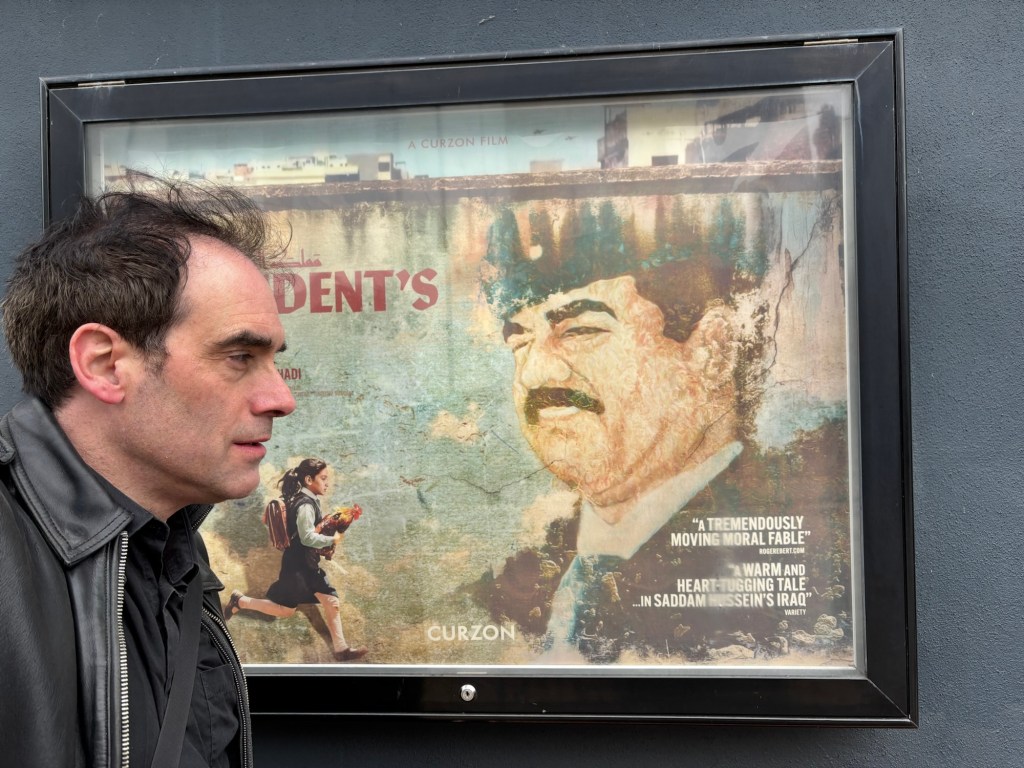
I had expected this perhaps to be a looser or more comedic film than it turns out to be. Instead, this Arabic-language debut from Iraqi filmmaker Hasan Hadi is a quietly devastating portrait of life under dictatorship. Set in 1990, it feels entirely rooted in another world — one without mobile phones or instant communication — where sanctions against Saddam Hussein’s Iraq have left food, medicine, and basic resources desperately scarce. Yet despite this hardship, every school is required to celebrate the president’s birthday.
Nine-year-old Lamia (Baneen Ahmad Nayyef) knows she cannot possibly afford to fulfil her teacher’s demand that each pupil contribute to the celebration, yet she proceeds anyway, at enormous personal cost. The teacher, already shown stealing an apple from a child’s bag, exerts tyrannical authority over his pupils both inside and outside the classroom, clearly relishing his own importance while repeatedly invoking his military background as justification for obedience.
As Lamia and her friend Saeed set out to obtain ingredients for the cake, they encounter a series of unsettling figures: a paedophile who attempts to lure Lamia to his apartment under the pretext of offering baking powder, and a grocer engaged in an inappropriate relationship with a customer. While the children stand guard over their precious supplies, the journey exposes a society shaped by fear, deprivation, and moral compromise.
Sociologically, the film feels deeply significant, offering a glimpse into the daily lives of the Marsh Arabs in southern Iraq under Hussein’s regime. It could almost be set at any point in the last century: food gathered from sparse vegetation in the Mesopotamian marshlands, families living in fragile thatched homes, and schoolchildren chanting slogans declaring they would die for Saddam — moments that feel chilling precisely because they are presented as ordinary.
Told entirely from a child’s perspective, the film carries a dreamlike quality. Begging, borrowing, stealing, and running away are simply part of survival, normalised within a harsh reality the children scarcely question. Like Italian neorealist films such as Bicycle Thieves, tragedy unfolds quietly within everyday life, and by the end the film reveals just how bleak and inescapable that world truly is.



 Chris Deacy
Leave a comment