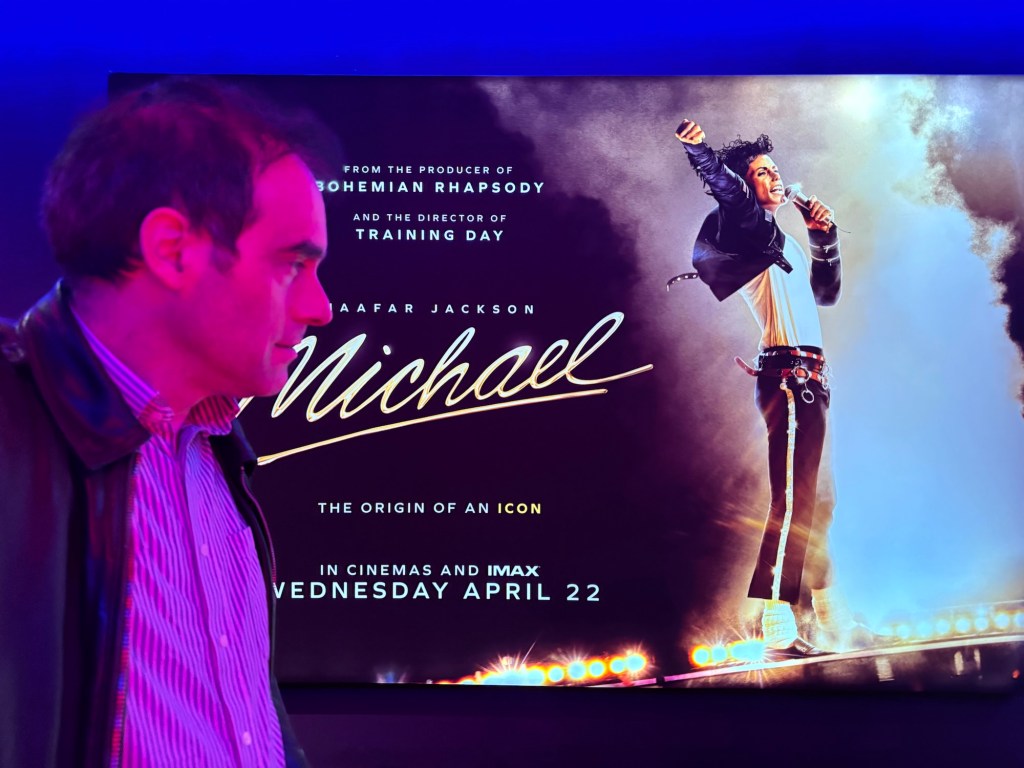
There was always going to be controversy surrounding a film like ‘Michael’, given the unresolved and deeply troubling allegations involving Michael Jackson and young children. This film perhaps conveniently avoids that territory by ending its story around 1988, before the controversies of the 1990s came to define much of his public image. On its own terms, however, it is an extremely accomplished biopic.
The film begins in 1966 in Gary, Indiana, where we see the formidable presence of Joseph Jackson (a very impressive Colmon Domingo), determined that his children will not remain trapped in a blue-collar life. His methods are harsh and often abusive, pushing the young Jackson brothers into a relentless schedule of rehearsals, performances and touring as the Jackson Five. This early section is particularly effective in showing both the discipline and the cost of that success.
Interestingly, Janet Jackson is not featured at all, not even referenced, which gives the impression of a family narrative that is selective, perhaps even contested. In the central role, Jaafar Jackson, the son of Jermaine Jackson, is a striking physical and vocal match for Michael, capturing both his talent and his growing eccentricity. The film leans into that image: the pet monkey, the llama, the sense of a life lived increasingly outside the ordinary.
At the same time, Joseph Jackson remains a looming, controlling figure. Even as Michael becomes a global star, there is something unsettling about the way he continues to live within the family orbit, with his father still exerting influence. The film taps into the idea of Michael as a kind of Peter Pan figure – the child who never truly grows up – shaped by a childhood that was anything but normal.
What makes this an engaging watch is its immersive quality. The musical sequences are exhilarating, capturing the energy and innovation that made Michael Jackson such a transformative performer. Yet there is also a sense that the film is only telling part of the story. The other Jackson brothers are present but largely underdeveloped, and their relationships with Michael never fully come into focus.
There are moments where the storytelling feels overly simplified – for instance, the suggestion that MTV’s resistance to black artists is resolved with a single phone call, played with surprising comic flair by an almost unrecognisable Mike Myers. These touches don’t derail the film, but they do hint at a tendency to smooth over more complex realities.
Ultimately, the film feels like the first half of a much larger story. It even signals this by suggesting that the narrative continues, though whether that means a sequel or simply an acknowledgement of what has been left unsaid remains unclear. What is certain is that this portrayal raises as many questions as it answers – and that to fully understand Michael Jackson as a person, a second chapter would need to grapple with the far more difficult aspects of his life.




Leave a Reply