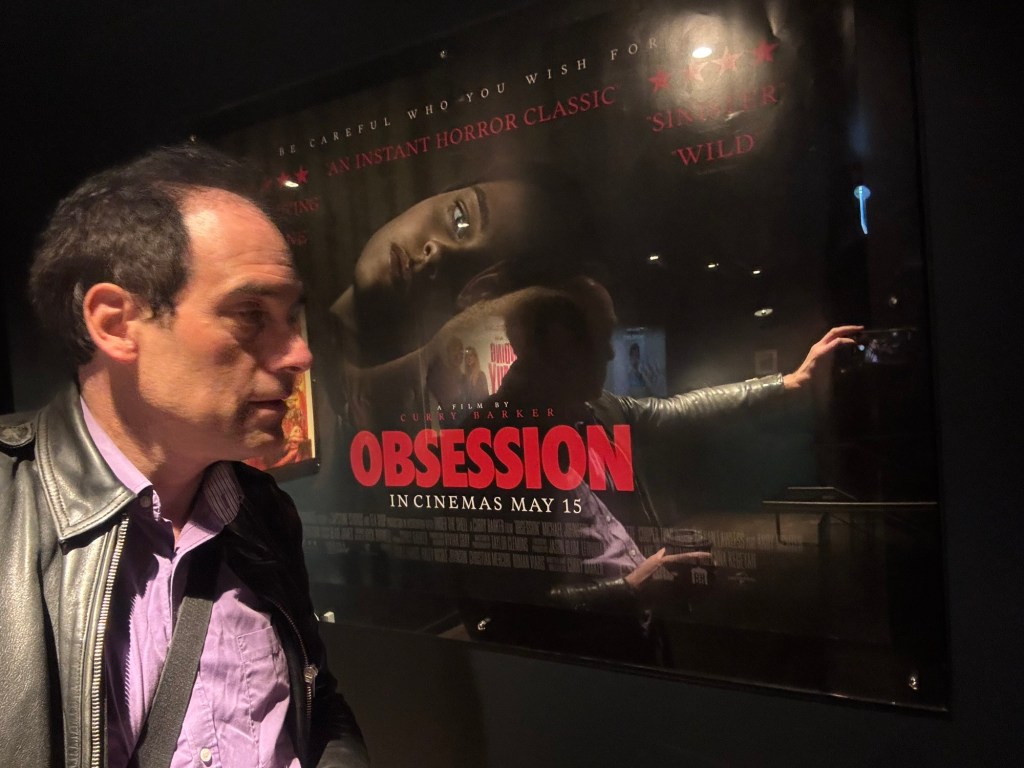
‘Obsession’ reminded me a little of ‘Flatliners’ in the sense that it explores characters trying to seize control over emotional outcomes rather than allowing life – or fate – to unfold naturally. This Blumhouse Productions horror film has a genuinely fascinating premise, raising unsettling questions about relationships, desire and the danger of trying to manufacture love according to our own fantasies rather than accepting people as they truly are.
At the centre is Bear (Michael Johnston), a shy and socially awkward young man who believes he may have a connection with a co-worker , Nikki (Inde Navarrette), at a music store, though he’s too afraid to test it in reality. Then, through the intervention of a strange mystical object – very much in the spirit of films like ‘Big’ or ‘Prelude to a Kiss’ – he acquires a ‘One-Wish Willow’, a novelty item bought from a New Age shop that grants a single wish when snapped in two. Bear wishes for Nikki to love him more than anyone else in the world, and what initially seems like a dream scenario quickly turns nightmarish.
The film plays almost like an extended episode of ‘The Twilight Zone’. Nikki’s behaviour becomes increasingly obsessive and terrifying. She turns possessive, jealous and emotionally unstable, and Bear gradually realizes that the fantasy he longed for is now imprisoning him. There are shades of ‘Smile’ in the way Nikki’s unnerving grin becomes something grotesque rather than affectionate, and the film taps into broader anxieties around toxic relationships and emotional dependency.
What’s clever is that ‘Obsession’ never loses sight of the emotional logic behind Bear’s decision. He fears that confessing his feelings naturally would destroy the friendship they already have, so he chooses the shortcut – magical intervention rather than vulnerability. The horror emerges from seeing how deeply unnatural that shortcut becomes. Nikki’s personality begins to warp entirely; she develops glazed expressions, manic outbursts and violent tendencies, committing shocking acts that feel completely disconnected from who she originally was.
In that sense, the film almost becomes a possession narrative, not unlike ‘The Exorcist’. It’s as though the real Nikki is trapped inside a version of herself rewritten by somebody else’s desire. The film raises disturbing questions about consent and autonomy because the love we’re witnessing is fundamentally artificial – not an authentic emotional connection but a personality imposed from outside.
What ‘Obsession’ ultimately does very well is interrogate the fantasy of total devotion. Many people imagine that having somebody completely obsessed with them would be ideal – unconditional love, constant desire, absolute emotional availability – but this film cleverly explores how horrifying that would actually become in practice. The terror lies precisely in the fact that this is not the real person at all, but a distorted projection created to satisfy somebody else’s needs.
The sound design also deserves praise. Like the ‘Smile’ films, it uses unsettling audio cues and tonal distortions to keep the audience permanently uneasy. The result is a psychologically sharp horror film that takes a deceptively simple idea and pushes it into genuinely disturbing territory.





Leave a Reply