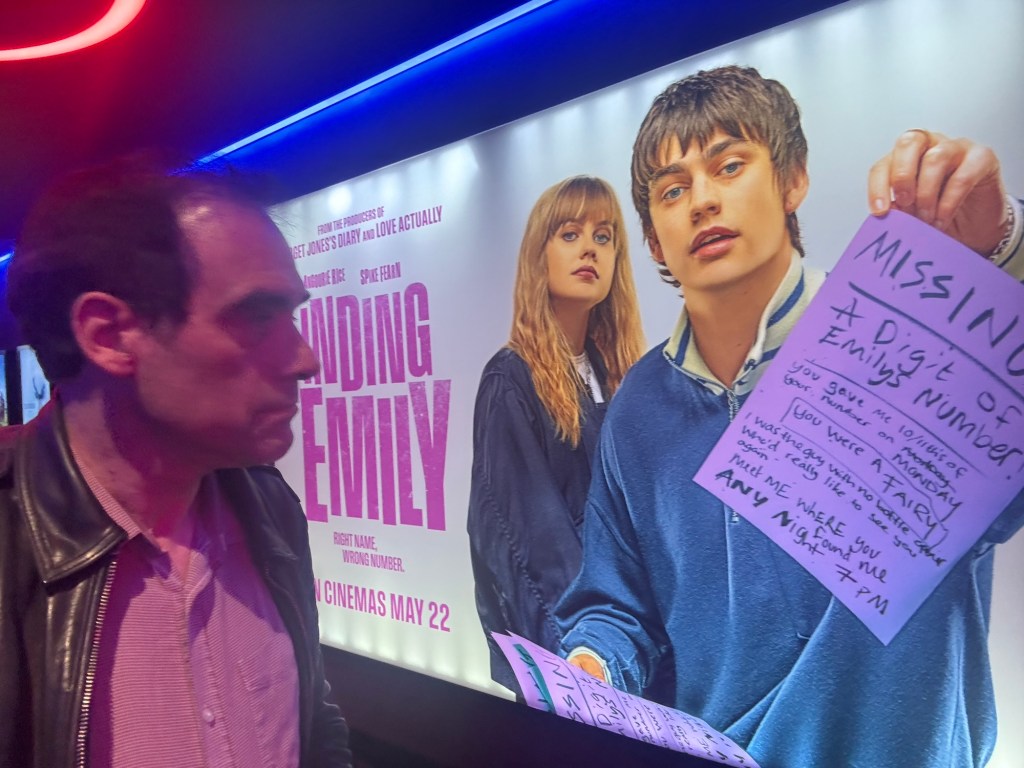
‘Finding Emily’ comes from the same sort of stable – at least in terms of its Working Title Films pedigree – that gave us films like ‘Notting Hill’ and ‘Bridget Jones’s Diary’. It operates in that familiar ‘what if?’ territory we’ve seen in films such as ‘Sliding Doors’, where chance encounters and alternative possibilities shape people’s lives. As somebody who spent a quarter of a century working in the university sector, though, I found parts of the set-up wildly implausible. The idea that a junior member of staff – here a sound engineer at a student union in Manchester – could suddenly gain access to the entire student database and email everyone in search of a girl he met after a night out is difficult to accept.
Still, the film becomes more interesting when it moves beyond the mechanics of the premise and starts asking larger questions. Owen (Spike Fearn) is searching for the mysterious Emily he met and immediately connected with, but then another Emily emerges – one who may in fact turn out to be a better match for him. It’s a genuinely intriguing idea, though I’m not sure the film fully exploits the possibilities within it.
At heart, it taps into a very relatable romantic scenario: meeting someone unexpectedly and becoming convinced they might be the person you’re meant to be with. But then reality intervenes. Owen continues searching for his original Emily while becoming increasingly involved with another Emily, who happens to be writing a Psychology dissertation on romantic love and, somewhat awkwardly, turns him into an unwitting case study. That introduces some interesting ethical questions, though the film itself approaches things in a lighter, more playful spirit.
It’s really a gentle satire of university life, student culture and dating in the digital age. There are some wildly exaggerated details – a campus radio station with giant public screens and production values rivaling national broadcasters – but they’re entertaining enough. Watching it, I found myself imagining alternative scenarios of my own. Owen’s original Emily gives him her phone number, but one digit is missing. Was it deliberate? Was it accidental? Is she waiting for him to call and assuming she’s being ghosted? The film cleverly mines all of those uncertainties that now shape modern relationships.
One of its stronger ideas is that the Emily studying love has built her dissertation around the belief that romantic attachment is simply an unnecessary evolutionary hangover destined to create pain and disappointment – only for her to begin falling for the very subject she’s analysing. There’s a nice irony there.
Minnie Driver also appears as the university’s Dean, constantly trying to brush off complaints surrounding the disastrous mass email leak, and I couldn’t help thinking how interesting it was that nearly thirty years earlier she herself had been playing a university student in ‘Good Will Hunting’. There’s also something of ‘When Harry Met Sally’ here in the sense of wondering where people may eventually end up. Is the person who dazzles you on a random night out really the person you could still imagine yourself with twenty or thirty years later? That question lingers long after the film ends.



Leave a Reply