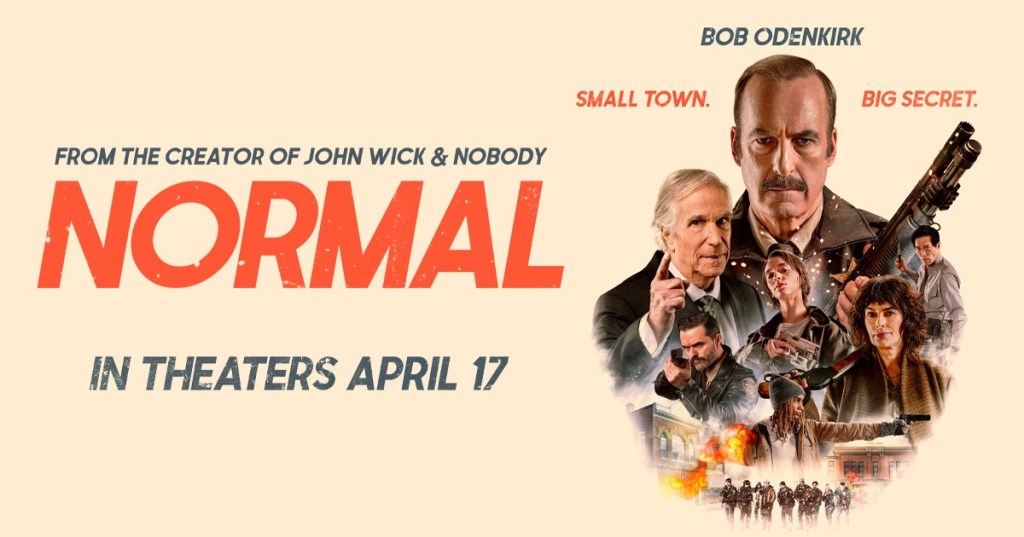
‘Normal’ is very much in the vein of ‘Nobody’, again starring Bob Odenkirk, and follows that familiar one-man-against-the-world template. Odenkirk plays an unassuming temporary sheriff who seems almost comically unsuited to confrontation. He doesn’t even issue parking tickets – if someone parks badly, he simply leaves a polite note asking them to do better next time. On the surface, he appears perfectly matched to this quiet, snow-covered Midwestern town where very little seems to happen and life moves at an unhurried pace.
But of course this apparent tranquillity proves deceptive. A genuine crisis erupts involving the Yakuza, who are secretly using a bank in this small Minnesota community to store weapons. Matters become even more complicated when outsiders arrive intending to rob the bank, unknowingly stumbling into something far more dangerous than they anticipated. Suddenly the mild-mannered sheriff finds himself pushed into the role of reluctant hero.
There are definite shades of ‘High Noon’ here, with the solitary lawman who realizes danger is approaching and understands that he may have to stand alone. What’s interesting is that initially the town’s conflicts seem entirely trivial – small disagreements and minor irritations that suggest his job requires very little effort. But much like ‘Blue Velvet’, the film is ultimately interested in exposing the darkness hidden beneath the surface of small-town America.
There are echoes too of ‘A History of Violence’ and the idea that someone who appears passive or incapable may, under the right circumstances, reveal an entirely different side of themselves. Likewise, ‘Cop Land’ comes to mind, where a sheriff eventually has to confront corruption around him, although here Odenkirk’s character is forced into action immediately rather than gradually.
Had this film been released a few decades ago it almost certainly would have carried an 18 certificate, with exploding heads and some remarkably gruesome violence. The difficulty, however, is that after ‘Nobody’ and its more pedestrian follow-up, the formula no longer feels especially fresh. It still works and it’s often very funny, but increasingly the beats become predictable.
There are interesting themes at work, particularly around the idea that the past inevitably catches up with us, though at times these are made a little too explicit, as though the screenplay is carefully ticking boxes rather than discovering things organically. There’s even a touch of ‘The Big Lebowski’ in Odenkirk’s Ulysses, whose line, ‘Life’s a lot easier when you carry a little less’, recalls Jeff Bridges’ reluctant drifter suddenly being pulled into events beyond his control.
Perhaps the film’s sharpest irony is that the sheriff ultimately finds himself protecting the bank robbers rather than the ordinary townspeople, because the townspeople themselves have fallen under the influence of the Japanese mafia. It’s an amusing reversal and one of the film’s stronger ideas, even if the overall experience occasionally feels as though it’s running on familiar tracks.



Leave a Reply