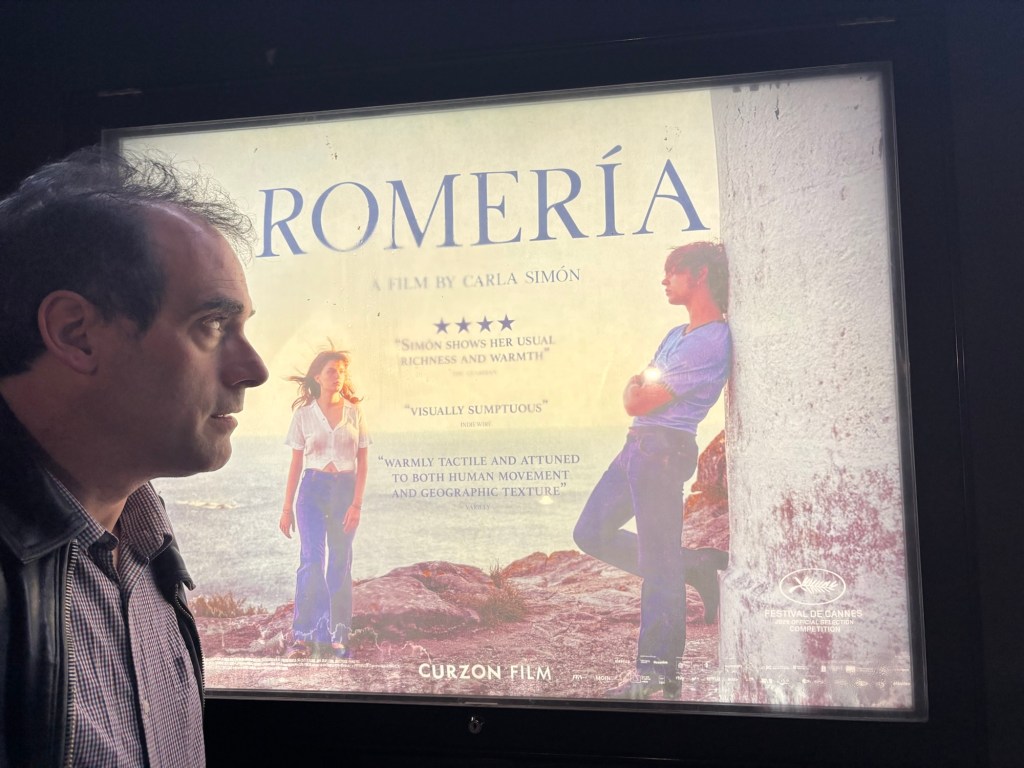
‘Romería’ is an intriguing film because it draws on diaries, fragments and half-truths – the kinds of stories and omissions that many families construct around themselves. At its centre is Marina (Llúcia Garcia), a young woman from Barcelona who in 2004 sets out to uncover the truth about a father she never knew. She is applying for a university scholarship and needs official details concerning her parents, but the search quickly becomes something much more personal. A filmmaker herself, she begins a journey into her own origins and identity.
With both parents now dead, Marina is dependent on relatives, especially grandparents, to fill in the gaps, but they have reasons of their own for withholding information. Much of that silence revolves around the stigma surrounding the drug addiction and HIV that led to her parents’ deaths. In that sense the film becomes a study of shame, secrecy and the stories families tell in order to protect themselves.
The pace is deliberately slow and gentle, almost drifting along, though it becomes increasingly fascinating as it develops. Marina travels to Vigo over the course of five days after discovering that she is not even named on her late father’s death certificate, preventing her from securing the scholarship. Her grandparents are wealthy enough that they could simply solve her financial problems, but Marina refuses the easy route. Instead she insists on following the proper process, forcing her family to confront truths that have remained hidden for years.
As the film unfolds, further revelations emerge. Marina discovers that the version of her father’s life she had always accepted may not be accurate at all. She had believed he died in 1987, yet evidence suggests he was alive for another five years, potentially long enough for her to have known him as a child. The mystery then shifts from whether he existed in her life to why he was absent from it.
What becomes especially interesting is the way the film merges memory and reconstruction. Marina begins filming and recreating footage based on her mother’s diaries which she reads throughout the film from decades earlier. There is almost an attempt to bring her parents back to life through cinema itself. The stylized, dreamlike sequences and Super-8-style flashbacks blur memory, imagination and reality.
The film does occasionally feel overly leisurely, and there are moments when the repetition of Marina’s search can become frustrating. But this is not really a detective story in the conventional sense. It’s about a young woman patiently and quietly trying to understand her own past.
Although ‘Romería’ remains elliptical throughout, at its heart lies a compelling question: who were our parents before we knew them, and can we ever truly reconstruct them? Marina is repeatedly told that she is the image of her mother, and in a clever touch her mother is portrayed by the same actress in the flashback sequences. The suggestion is that in searching for her parents, Marina may also be creating them anew in her own image – though whether that ultimately brings the closure she seeks is another question entirely.



Leave a Reply