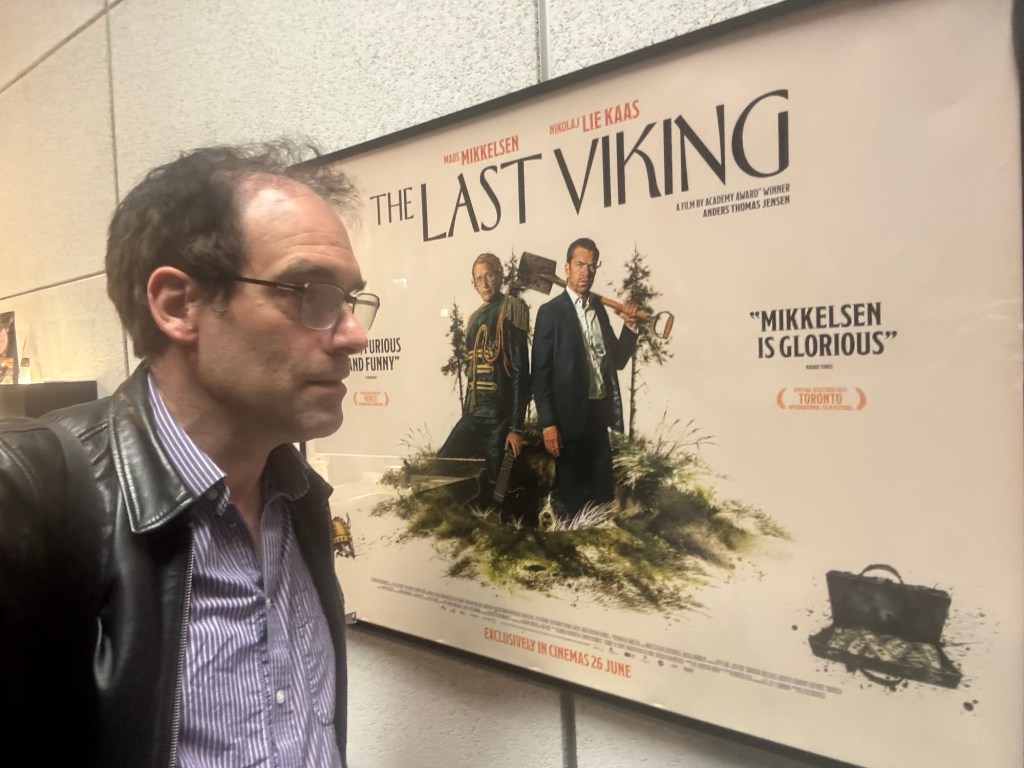
‘The Last Viking’ is a wonderfully hybrid black comedy that tackles questions of mental illness head-on while simultaneously giving us what, in other hands, might have been a more conventional bank-heist caper. This audacious Danish film stars Mads Mikkelsen as a man who, having been traumatised and bullied as a child, has come to believe that he is John Lennon. This proves maddening for his brother, newly released from prison, whose only concern is recovering the proceeds of a robbery. Before being incarcerated, he entrusted his brother with information about where the money was buried, and now finds himself having to navigate layer upon layer of mental illness, personality disorder and unresolved family trauma in order to locate it.
At first, the brother is dismissive of these issues. He sees them as obstacles standing between himself and the loot. Yet he gradually realises that if he is ever going to recover the money, he must enter into his brother’s world rather than reject it. The self-proclaimed Lennon refuses to acknowledge his real name, and there are several hilarious scenes in which he reacts to pressure by abruptly jumping out of cars or fleeing buildings. He is volatile, unpredictable and still deeply resentful that his brother was absent for so many years in prison.
What makes the film particularly clever is that it then doubles down on its central premise. If one man believes he is John Lennon, why not locate other psychiatric patients who believe they are the remaining members of The Beatles and reunite them for a concert? Naturally, this increasingly absurd mission becomes intertwined with the search for the buried money. The result is both ludicrous and strangely touching. When the various ‘Beatles’ are assembled, one of them believes he is simultaneously George Harrison and Paul McCartney, while another suddenly performs as though he were a member of ABBA. Musically and psychologically, the film becomes a glorious collision of identities.
There is, however, a darker side. The film contains scenes of brutality, abuse and violence that are genuinely shocking. Child abuse, trauma and neglect are woven into the narrative, and the film never sanitises the damage they can inflict. Yet somehow it manages to move seamlessly between violence, comedy, drama and psychological exploration, sometimes within the same scene. It throws curveball after curveball and remains consistently unpredictable.
The comedy is heightened by the fact that the former family home, where the money is supposedly buried, has now been transformed into an Airbnb run by an eccentric couple. This creates further complications and misunderstandings as increasingly bizarre characters descend upon the property. The film revels in chaos, but there is also a serious point beneath the absurdity.
Ultimately, ‘The Last Viking’ works as a parable about stigma, identity and acceptance. Its underlying message seems to be that if everyone is broken, then perhaps no one is truly broken. The film suggests that society often focuses too much on what people lack rather than on how we might adapt our environments to help them flourish. If somebody genuinely believes they are John Lennon, the answer may not be to ridicule or dismiss them, but to find ways of engaging with that reality compassionately.
What lingers most is the film’s sense of difference. There is a wonderful sequence in which the various would-be Beatles prepare for their reunion concert, each singing a completely different song and appearing almost oblivious to the others. It is chaotic, ridiculous and deeply moving all at once. In celebrating the things that make us eccentric, damaged and unique, ‘The Last Viking’ becomes a gleefully touching film about family, belonging and the many ways people struggle to find harmony with one another.




Leave a Reply