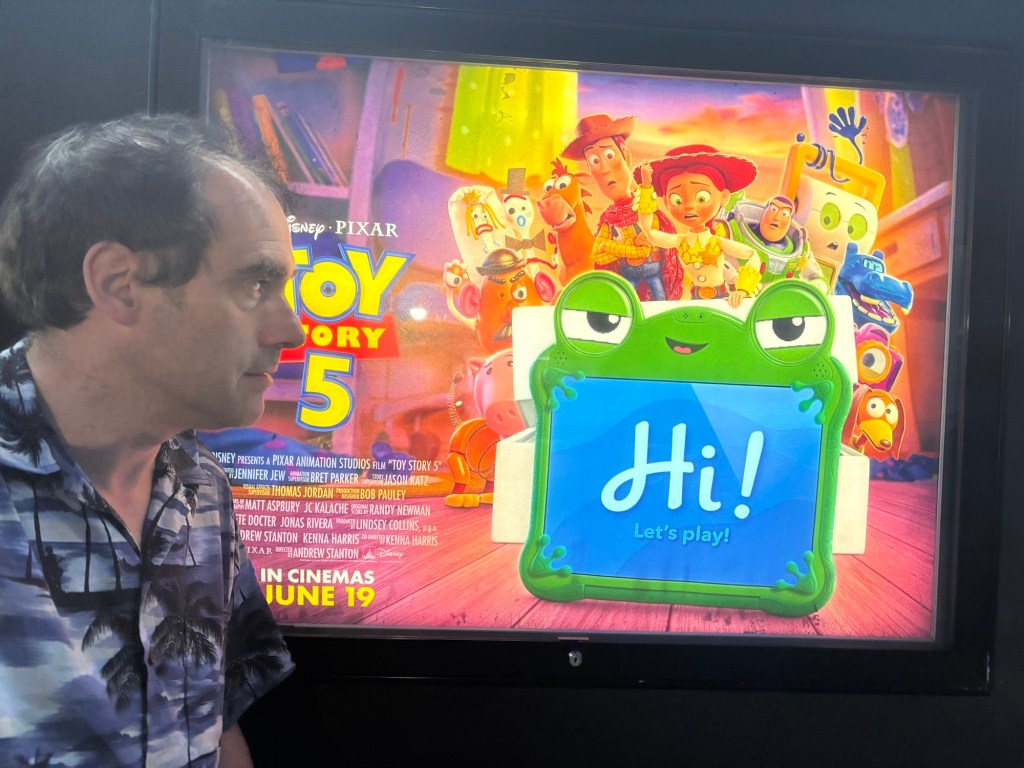
I found ‘Toy Story 5’ an intriguing addition to the ‘Toy Story’ universe because it feels unusually timely and, in some respects, rather conflicted. The film arrives at a moment when there is growing concern about the amount of time children spend on screens, with governments, schools and parents increasingly debating the impact of social media, smartphones and digital technology on young lives. In that sense, this feels like the obvious ‘Toy Story’ film to make.
The premise is simple but effective. Bonnie, now eight years old, becomes increasingly attached to a device called Lilypad, through which she forms friendships and spends much of her time interacting with the digital world. Unsurprisingly, the toys fear they are being left behind. The anxiety is familiar because obsolescence has always been at the heart of the ‘Toy Story’ series. In the original film, Woody feared being replaced by the newer, more technologically advanced Buzz Lightyear. Here, the threat is even greater: it is not one toy replacing another, but the possibility that toys themselves have become obsolete.
What struck me is that the film often feels less like an adventure and more like a cautionary tale. It has something of the old public-service-message quality about it, almost as if it is saying, ‘Put down your screen and reconnect with the real world.’ The message is not exactly subtle. There is an irony too in the fact that this comes from a studio that is itself heavily invested in keeping audiences engaged with screens. The film repeatedly suggests that life was somehow better before digital devices, when friendships were formed face to face and imaginative play was centred on dolls, toys and physical interaction.
The difficulty is that the film itself acknowledges a more complicated reality. Lilypad is not portrayed as entirely negative. Bonnie genuinely forms connections through it, and there are moments when the device appears to enrich her life rather than diminish it. As a result, the film feels somewhat conflicted about the argument it is trying to make.
Narratively, much of the story consists of rescue missions and attempts by the toys to remain relevant. At times this makes the film feel a little redundant, revisiting themes that have always been present in the franchise. Yet there is something poignant in the way the toys continue to experience emotions so intensely. As ever, they possess recognizably human feelings, and when they are abandoned, ignored or placed in a drawer, they experience genuine hurt and even trauma.
Part of me wished the film had pushed its ideas further. The ‘Toy Story’ series has always contained surprisingly profound reflections on ageing, change and mortality, and this instalment could perhaps have explored more deeply what it means for an entire category of objects to become irrelevant. Instead, it remains largely within the boundaries of family entertainment.
Even so, the film’s central question is an interesting one. If earlier ‘Toy Story’ films asked whether one toy could replace another, ‘Toy Story 5’ asks whether toys themselves still have a place in a digital age. That is a genuinely fascinating idea, even if the film ultimately approaches it in a way that is more sentimental than existential. As a result, it is engaging and thought-provoking, though perhaps not quite as profound as the themes it touches upon.






Leave a Reply