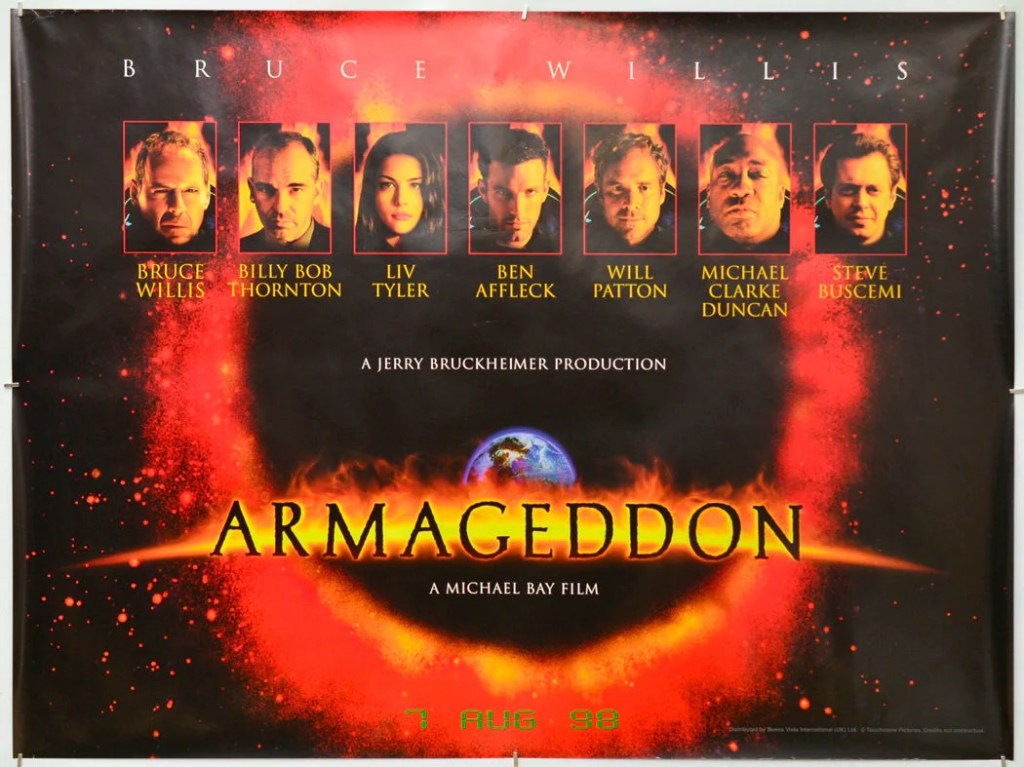
‘Armageddon’ is one of those gloriously overblown disaster movies that scarcely pauses for breath. The premise is wonderfully simple: an asteroid the size of Texas is on a collision course with Earth, with just eighteen days before impact. NASA predicts what one character calls ‘the worst parts of the Bible’, and once again it falls to Bruce Willis to save humanity. His solution is to fly to the asteroid, drill an 800-foot hole into its core and detonate a nuclear weapon. Willis, however, will only agree on one condition: he gets to take his own oil-drilling crew, a wonderfully eccentric collection of criminals, misfits and reprobates who somehow become humanity’s last hope.
Directed by Michael Bay, the film is relentlessly energetic. The rapid-fire editing, soaring music and slow-motion heroics often make it feel less like a conventional film than an extended rock music video. It is undeniably entertaining, but it is also riddled with plot holes almost as large as the crater the characters are trying to drill. The crew wander around the asteroid as though its gravity were identical to Earth’s, while Ben Affleck at one point happily drives a lunar buggy across its surface as though he were back in Texas. The science is gloriously implausible, but Bay’s priority is clearly spectacle rather than realism.
Alongside the disaster narrative runs a romantic subplot involving Affleck’s young driller and Bruce Willis’s daughter, played by Liv Tyler. Willis’s character is horrified that his beloved daughter might marry one of the roughnecks he has spent his life working alongside, and inevitably the film builds towards an act of self-sacrifice that resolves both the planetary crisis and the family drama. One contemporary reviewer observed that ‘only near the end, when every second counts, does the movie slow down’, as the hero delays saving the Earth in order to deliver an emotional farewell speech. That criticism is entirely fair, but it is also part of the film’s unabashedly sentimental appeal.
Curiously, despite depending so heavily on oil drilling for its premise, the film tells us remarkably little about the drilling process itself. We are simply expected to accept that these blue-collar workers possess skills so unique that they can succeed where trained astronauts cannot. It is less interested in engineering than in celebrating working-class heroism and the idea that ordinary people can achieve extraordinary things.
Theologically, ‘Armageddon’ is also an interesting title. It borrows the biblical language of apocalypse and repeatedly invokes imagery associated with the end of the world. Yet despite its references to catastrophe, it is not really an apocalyptic film in the biblical sense. In the Book of Revelation, Armageddon is the site of the final battle between good and evil, where God decisively defeats the forces of darkness and inaugurates a new creation. Here, there is no divine intervention, no cosmic struggle between moral opposites and no establishment of God’s kingdom. The approaching asteroid is not evil but simply a natural object, and the solution is technological rather than spiritual.
In that respect, the title is somewhat misleading. The film promises biblical apocalypse but ultimately delivers melodramatic heroism. There is certainly self-sacrifice, courage and redemption, but these are human rather than divine virtues. The world is saved not by providence but by engineering, determination and the willingness of one man to lay down his life for others.
For all its scientific absurdities and emotional excesses, however, ‘Armageddon’ remains hugely entertaining. It captures the late-1990s blockbuster formula at its most extravagant, combining disaster spectacle, broad comedy, romance and unabashed sentimentality. It may ask us to suspend our disbelief almost continuously, but it rewards that suspension with an exhilarating ride that never pretends to be anything other than a celebration of larger-than-life cinematic heroism.






Leave a Reply