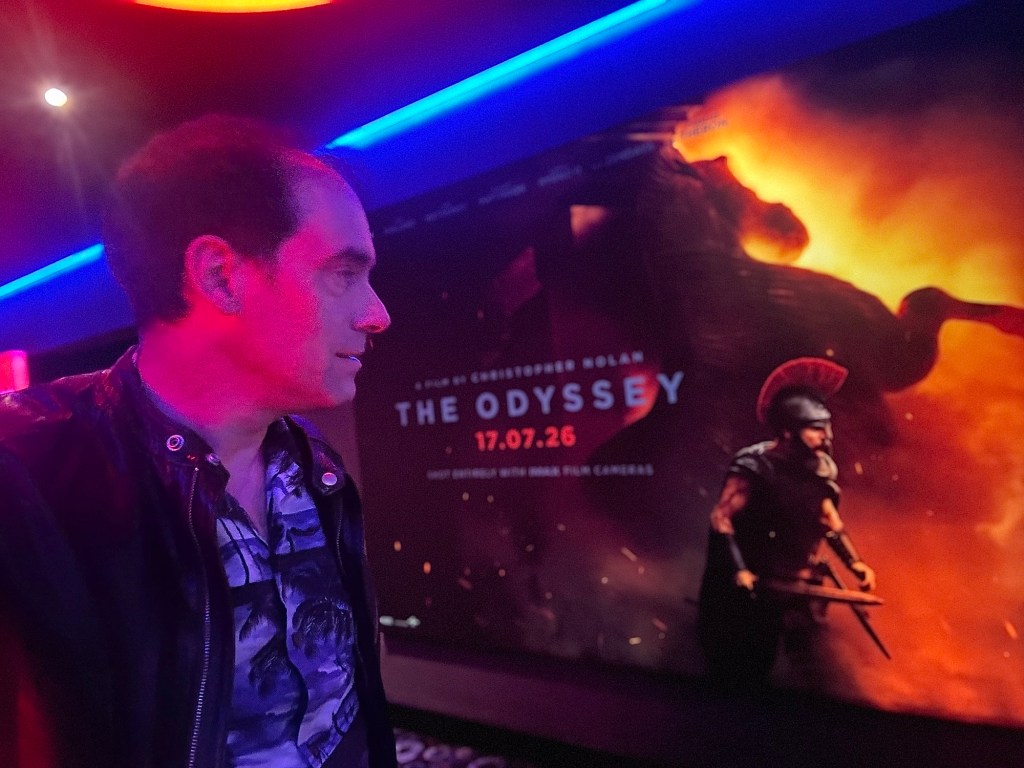
Christopher Nolan’s ‘The Odyssey’ is perhaps the most ambitious film of his career, adapting one of the foundational texts of Western literature while filtering it through the themes that have fascinated him for decades: memory, time, identity, guilt, destiny and the elusive search for home. Homer’s epic has inspired everything from ‘The Wizard of Oz’ and ‘Star Wars’ to ‘O Brother, Where Art Thou?’, while Martin Scorsese’s ‘Taxi Driver’ has often been interpreted as a modern Odyssey in which the wandering warrior returns home psychologically incapable of reconnecting with society. Nolan clearly understands that this is not simply an adventure story filled with monsters and gods, but the archetype from which so much subsequent storytelling has emerged.
If I have one reservation, it is that after seeing so many reinterpretations of Homer’s poem over the years, I found Nolan’s version slightly less revelatory than I had hoped. It is an extraordinary achievement, but perhaps one weighed down by the immense cultural shadow cast by the source material itself. Even so, it remains an engrossing and intellectually stimulating piece of filmmaking.
Matt Damon gives a strong performance as Odysseus, abandoning the image of the swaggering warrior in favour of a man physically exhausted and spiritually broken. This is less a conquering hero than a veteran suffering the invisible wounds of war. Nolan transforms the ten-year voyage home from Troy into a meditation on post-traumatic stress. Many soldiers return home physically after conflict; returning emotionally is often a far longer journey, and sometimes one that is never completed. Odysseus is perpetually trying to find his way back not simply to Ithaca, but to the person he once was before the Trojan War.
Meanwhile, Penelope (Anne Hathaway) struggles to preserve the kingdom against the opportunistic suitors circling the throne, while Telemachus (Tom Holland) searches for a father he scarcely remembers and does not even know is still alive. In that respect, ‘The Odyssey’ often resembles ‘The Godfather’, becoming a story not simply about loyalty but about the collapse of loyalty within a family, and the struggle to preserve a legacy when its patriarch has disappeared.
Nolan wisely resists making the supernatural the film’s dominant feature. Samantha Morton is mesmerising as Circe, whose transformation of men into swine feels as psychologically unsettling as it is magical, while the descent into the Underworld becomes one of the film’s most haunting sequences. Here Nolan imagines the dead emerging like the witches of Macbeth, hovering uneasily between the worlds of the living and the divine. Rather than treating mythology as fantasy, he presents the gods almost as manifestations of fate itself – forces that are neither benevolent nor malevolent but simply indifferent to human suffering.
What fascinated me most was Nolan’s suggestion that perhaps the gods are not entirely responsible for delaying Odysseus’ return. There is an underlying implication that the greatest obstacle is Odysseus himself. Burdened by guilt over the devastation of Troy and perhaps feeling fundamentally unworthy of happiness, he becomes complicit in prolonging his own exile. Throughout the film, chance and fate seem locked in constant dialogue. Is his journey ordained by the gods, or is it the consequence of his own moral failings? Nolan never provides a simple answer.
The director’s fascination with fractured chronology proves perfectly suited to Homer. After all, ‘The Odyssey’ itself is not told in a linear fashion, with much of the narrative unfolding through recollection. Nolan, whose films from ‘Memento’ to ‘Inception’, ‘Interstellar’ and ‘Tenet’ have repeatedly explored the elasticity of time, uses flashbacks and shifting perspectives to mirror the fragmented nature of memory itself. Rather than feeling like one of his trademark structural games, the non-linearity feels entirely organic to the material.
Visually, the film is astonishing. Nolan once again favours practical spectacle over digital excess, creating vast landscapes and large-scale action that possess genuine physical weight. Yet for all its epic scale, this is a remarkably intimate film. The Cyclops, the Sirens, Scylla and Charybdis are less important than the internal battles Odysseus wages with grief, regret and identity. There is no attempt to recreate ancient languages or present the story as an archaeological artefact. Instead, the dialogue is contemporary, allowing the emotional truths of Homer’s poem to resonate directly with a modern audience.
Ultimately, ‘The Odyssey’ becomes a film about stories themselves – how they shape identity, preserve memory, conceal guilt and offer hope. It asks whether home is a place we return to or a state of mind we spend our lives trying to recover. Like all great epics, it understands that the destination is almost incidental. The true meaning lies in the journey, in every temptation resisted, every threshold crossed and every sacrifice made along the way.
Whether ‘The Odyssey’ ultimately does for Greek mythology what Peter Jackson achieved for Tolkien or Ridley Scott accomplished for the ancient world in ‘Gladiator’ remains to be seen. What is beyond doubt is that Christopher Nolan has crafted a thoughtful, haunting and intellectually ambitious interpretation of Homer’s masterpiece – less concerned with monsters than with memory, less about heroism than healing, and more interested in the long road home than the moment of arrival.




Leave a comment