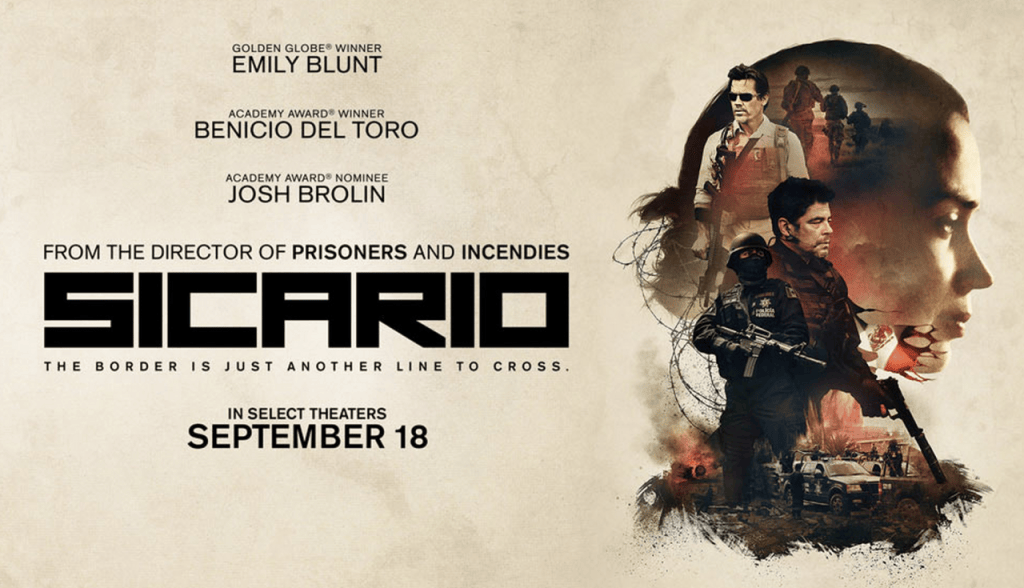
Denis Villeneuve’s ‘Sicario’ is a tense thriller about America’s war against the Mexican drug cartels, but what makes it so unsettling is that the people supposedly fighting on the side of justice seem increasingly indistinguishable from the criminals they’re pursuing.
There are obvious echoes of Steven Soderbergh’s ‘Traffic’, not least because Benicio Del Toro appears in both films, and both explore the apparently endless conflict between American law enforcement and the drug trade across the Mexican border. But where ‘Traffic’ examined the problem from several different perspectives, ‘Sicario’ places us firmly alongside somebody who has almost no idea what’s happening.
Emily Blunt plays Kate Macer, an FBI agent recruited into a mysterious operation ostensibly intended to bring a powerful drug cartel leader to justice. She’s intelligent, capable and committed to upholding the law. Unfortunately, nobody seems particularly interested in explaining the rules of the operation she has joined.
Josh Brolin plays Matt Graver, an American operative whose cheerful informality conceals a thoroughly ruthless approach to his work. He describes his job as creating chaos. And that’s precisely what he intends to do. Rather than simply arresting individual criminals, the strategy involves disrupting the cartels’ operations so violently that the people controlling them will be forced to reveal themselves.
It’s a form of warfare in which the conventional distinction between policing and criminality has almost disappeared. And Kate gradually discovers that she’s been recruited less for her investigative abilities than for the legitimacy her presence can confer upon an operation whose methods are morally questionable, to say the least.
That’s the film’s central tension. Can you defeat an enemy who recognizes no rules without abandoning your own? And if you do abandon them, what exactly have you won? Del Toro’s character, Alejandro, introduces another dimension. He’s a mysterious, almost spectral presence whose personal history gradually reveals the extent to which the drug war has become a matter of private vengeance.
His wife and daughter were murdered by the cartel, and his determination to exact revenge has effectively consumed whatever remains of his former identity. He’s less a conventional law-enforcement officer than a gunslinger pursuing a blood feud.
Indeed, ‘Sicario’ often feels like a modern Western. The vast desert landscapes, the dangerous border crossings and the sense of lawlessness all recall a world in which civilization is little more than a fragile agreement, easily abandoned when circumstances become sufficiently desperate.
Villeneuve’s direction is impressive. The widescreen compositions, particularly the twilight skies over the desert, give the film an almost mythic quality. There is something beautiful and terrifying about these landscapes, where the horizon seems limitless but the possibilities for escape are remarkably few.
The ominous, throbbing score creates an atmosphere of almost unbearable dread. It’s an approach Villeneuve would later employ to similarly powerful effect in ‘Dune’, where sound and image combine to suggest forces considerably larger than the individuals caught within them.
The action sequences are brilliantly choreographed, but what impressed me most was the way the film generates suspense from anticipation rather than simply from violence itself. We frequently know that something dreadful is about to happen. We just don’t know precisely when, or to whom. And when violence does erupt, it’s sudden, brutal and disturbingly matter-of-fact.
I was also reminded of ‘The Godfather’, particularly in the way organized crime exists alongside apparently ordinary family life. People sit around tables, eat meals, talk to their children and behave as though their domestic world has nothing whatsoever to do with the atrocities committed on their behalf.
There’s even something of ‘The Zone of Interest’ in that contrast between everyday normality and unimaginable brutality. The most disturbing people aren’t necessarily those who appear monstrous. They’re the ones who can commit or authorize terrible acts and then return home to dinner. This is a world in which evil is hiding in plain sight.
And the film’s suggestion that the violence of the Mexican cartels will eventually spread into American communities gives the conflict an additional sense of urgency. But that urgency also becomes a justification for almost anything. The threat is so enormous, we’re told, that conventional legal and moral restraints have become luxuries nobody can afford.
Kate is increasingly horrified by what she witnesses, yet her objections seem almost irrelevant to the machinery operating around her. She’s the person who still believes in the rules, trapped among people who have decided that rules are precisely what prevent them from winning.
And that’s what makes ‘Sicario’ such an effective and disturbing thriller. It isn’t simply about the difficulty of defeating organised crime. It’s about the moral damage inflicted upon those who convince themselves that the only way to fight evil is to become more ruthless than the people they’re fighting.
In the old Westerns, the arrival of the lawman meant that civilization might finally triumph over lawlessness. In ‘Sicario’, the terrifying question is whether the lawman has become just another outlaw with a badge.





Leave a Reply